

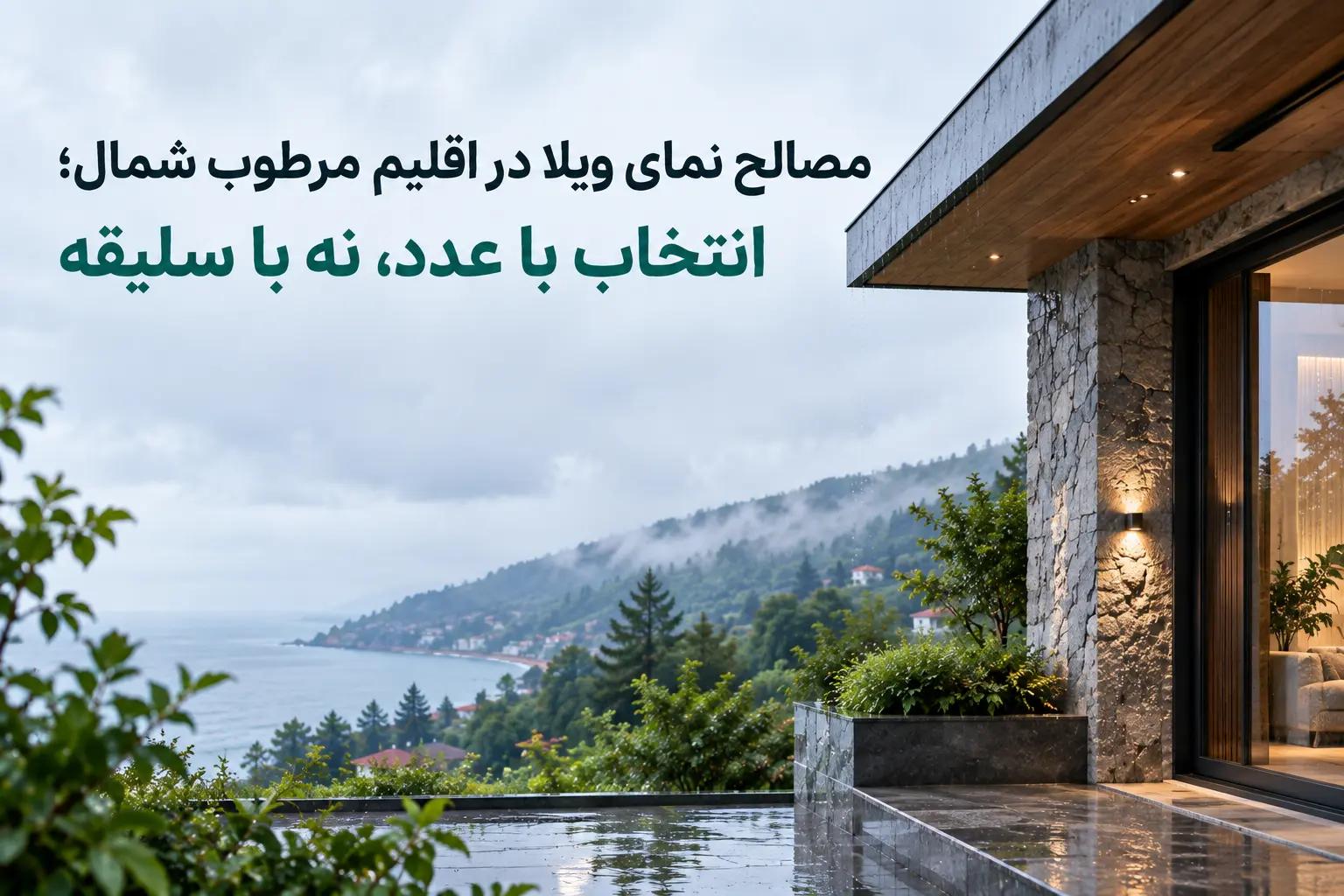
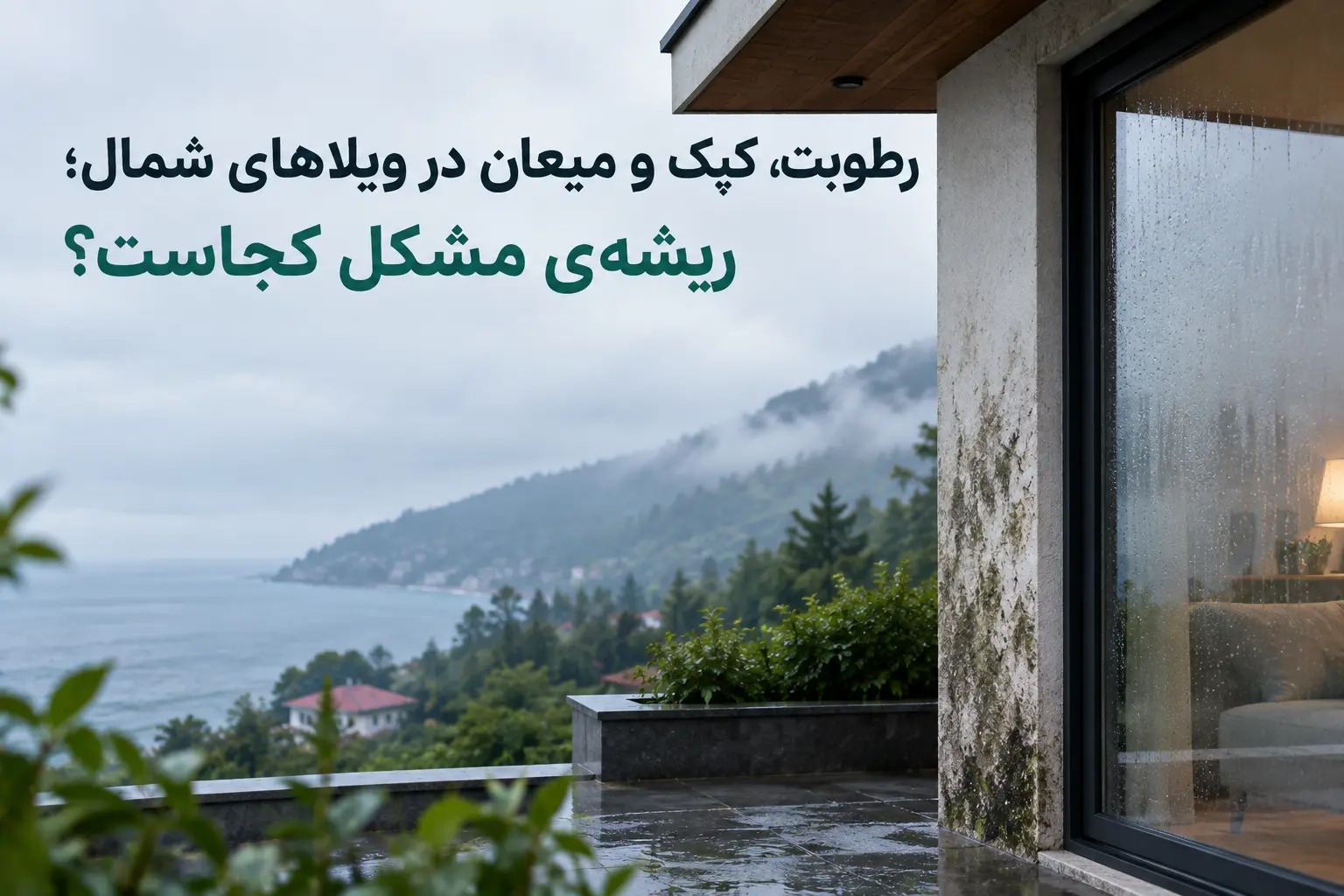
A facade that stays clean for ten years in a dry Iranian city can stain and go green within two winters in Sarkhorud. The material did not change; the climate did.
And the trouble is that facade materials are almost always chosen from a catalogue photograph — that is, on what the material looks like on day one, not on what it will be in year five. This article offers a numerical criterion to replace that instinct.
The ground we are standing on
Sixty-six years of records from the Babolsar synoptic station, published by the Mazandaran Meteorological Office:
- Annual precipitation: 896 mm
- Rainy days: 105 per year
- Mean relative humidity: 80%
Source: Mazandaran Meteorological Office — Babolsar climate
Your facade therefore gets wet roughly every third day, and between rains it sits in 80% humidity, which slows drying. That combination — frequent wetting plus slow drying — is what destroys materials.
Note that the primary threat here is not freeze–thaw. Babolsar’s winter is classified as mildly cold, not severe. What ruins facades on this coast is persistent moisture: staining, efflorescence, algal and moss growth, and delamination from the substrate.
Criterion one: water absorption
Every facade material absorbs some percentage of its own weight in water. The figure is measured by standard test — for stone, ASTM C97: specimens are oven-dried for 48 hours and weighed, then immersed for 48 hours and weighed again. The difference, as a percentage, is the absorption.
Now look at the numbers. These are the ASTM maximum permitted values:
| Material | Standard | Max water absorption |
|---|---|---|
| Marble | ASTM C503 | 0.20% |
| Slate | ASTM C629 | 0.25% |
| Granite | ASTM C615 | 0.40% |
| Porcelain tile (group BIa) | ISO 13006 | 0.5% |
| Quartzite | ASTM C616 | 1% |
| Low-density limestone | ASTM C568 | up to 12% |
Sources: Natural Stone Institute — ASTM standards for dimension stone and The Importance of Testing When Specifying Natural Stone
Look at the gap between the first and last rows: 0.2% against 12%. One material takes on up to sixty times as much water as another. Both are “natural stone”, and they sit side by side in the same catalogue.
A material that absorbs water does two things, and both are bad here:
- It stains. Water dissolves salts from the stone, the joints and the mortar and carries them to the surface. That white bloom on facades is efflorescence.
- It hosts growth. A surface that stays damp for weeks is a substrate for algae and moss. The green you see on north elevations is not random: the north face gets less sun, so it dries more slowly.
Travertine: let us be honest
Travertine is Iran’s most-used facade stone, and its beauty is not in question. But travertine is inherently porous — the same fine voids that give it its character are also the route water takes in.
This does not mean “never use travertine”. It means that in this climate travertine comes with conditions: genuine void filling (powder or resin), periodic sealing, detailing that sheds water properly, and accepting that it needs more maintenance than granite.
If the client does not want that maintenance, it is better to choose another material at the outset. The worst outcome is travertine specified without those conditions, and nobody owning the stains three years later.
Timber: the honest answer
Timber has deep roots in northern Iranian architecture and clients love it. But ordinary timber at 80% humidity is fungal food.
The industrial answer is ThermoWood: timber heated to around 212 °C in an oxygen-free kiln. That heat decomposes the hemicellulose — the sugars fungi feed on. With no food source, rot cannot establish.
| Property | ThermoWood |
|---|---|
| Equilibrium moisture content | 4–7% |
| Moisture uptake vs unmodified timber | 40–50% lower |
| Durability class (EN 113) | Class 1 or 2, by species and treatment intensity |
Source: International ThermoWood Association / Lunawood
Two things the supplier usually will not mention: ThermoWood is not immune to UV greying (it will silver unless periodically oiled), and thermal modification slightly reduces mechanical strength — so it is unsuitable for structural members. For cladding, it is appropriate.
And now the thing that matters more than the material
If you read only one section, read this one.
You can specify the most expensive stone available and still end up with a failed facade, if there is no air moving behind it.
The established answer in humid climates is the ventilated rainscreen: an air cavity between the cladding and the structural wall, with openings top and bottom. That cavity does two things:
- Drainage. Water that gets past the joints runs down the cavity and exits at the bottom instead of soaking into the wall.
- Drying. Warmed air rises and escapes at the top, pulling cooler air in below — a continuous flow that keeps the back of the cladding dry.
And the difference has been measured: walls with absorptive cladding and no drainage cavity hold sheathing moisture above 20% for extended periods; identical walls with a rainscreen stay below 15% year round.
Source: Sto Corp — Ventilated Rainscreen Systems
Which means facade detailing decides more than the material does. A mid-range stone detailed correctly will outlast an excellent stone stuck flat onto a wall.
Small details with large effects
- Drip edges. A profile that throws water clear of the face instead of letting it wrap back underneath. Their absence is why you see vertical black streaks below windows.
- Falls on horizontal surfaces. Every horizontal element — copings, sills, heads — needs a fall away from the building. A level surface is a pond.
- Roof overhang. Every extra centimetre of overhang is rain that never reaches the wall. In a climate with 105 rainy days, that simple geometry beats any chemical coating.
- Clearance above ground. The lowest 30–50 cm takes the worst of the splash-back. Running the same material straight down to grade is where staining starts.
- Joints and mortar. On many stained facades the stone itself is intact and the joint has failed. The joint is the weak link.
How to choose, then
- Ask for the absorption figure. If the supplier does not know it or cannot document it, that is itself an answer.
- Treat elevations separately. The north face and the face into the prevailing wind and rain have harder conditions. The whole building need not be one material.
- Ventilate behind the cladding. This decision outweighs the choice of material.
- Put maintenance on the table early. Some materials trade beauty for upkeep. That bargain should be conscious, not discovered in year three.
- See a sample on site, not in a catalogue. If you can, leave one outdoors on the plot for a few weeks and watch how it behaves.
How this connects to the rest of the building
The facade is not the only layer dealing with moisture. What happens behind it — continuous insulation, elimination of thermal bridges, condensation control — determines whether damp reaches you from the inside as well. We cover that in damp, condensation and mould in Caspian villas, and reading the two together gives the full picture.
Facade selection is also one of the clearest places where this climate diverges from Tehran’s — see villa design north vs Tehran.
And on cost: replacing a facade after construction is among the most expensive corrections there is. It is one of the items in the mistakes that raise build cost.
In short
A good facade in this climate is not an expensive one; it is one that gets wet and dries fast.
That takes two things: a material with low water absorption, and detailing that lets air move behind it. With both, even ordinary materials last well. Without them, the most expensive stone will not save you.
If you are designing a villa in Babol, Babolsar or Sarkhorud and want the facade chosen on these criteria, get in touch.

No comments yet. Be the first.