


It’s July, noon, in Babolsar. The evaporative cooler you brought from Tehran is on, blowing air and making noise. But the room doesn’t get cool; it just gets somehow damper. The sheets feel clammy and there’s a musty smell.
The cooler isn’t broken. Northern air isn’t made for this job, and the numbers show it.
How exactly does an evaporative cooler cool?
An evaporative cooler passes air over wet pads. Water evaporates, and to evaporate it takes heat from the air. But this has a ceiling, called the wet-bulb temperature: the lowest temperature air can reach through evaporating water alone. The drier the air, the bigger the gap between the normal temperature and the wet-bulb temperature, and the more room for cooling. The more humid the air, the smaller that gap.
Wikipedia gives two practical numbers. First, a residential evaporative cooler usually cools air to 3 to 4 °C above the wet-bulb temperature, not below. Second, a general recommendation is to use direct evaporative cooling where the outdoor wet-bulb temperature doesn’t exceed 22 °C.
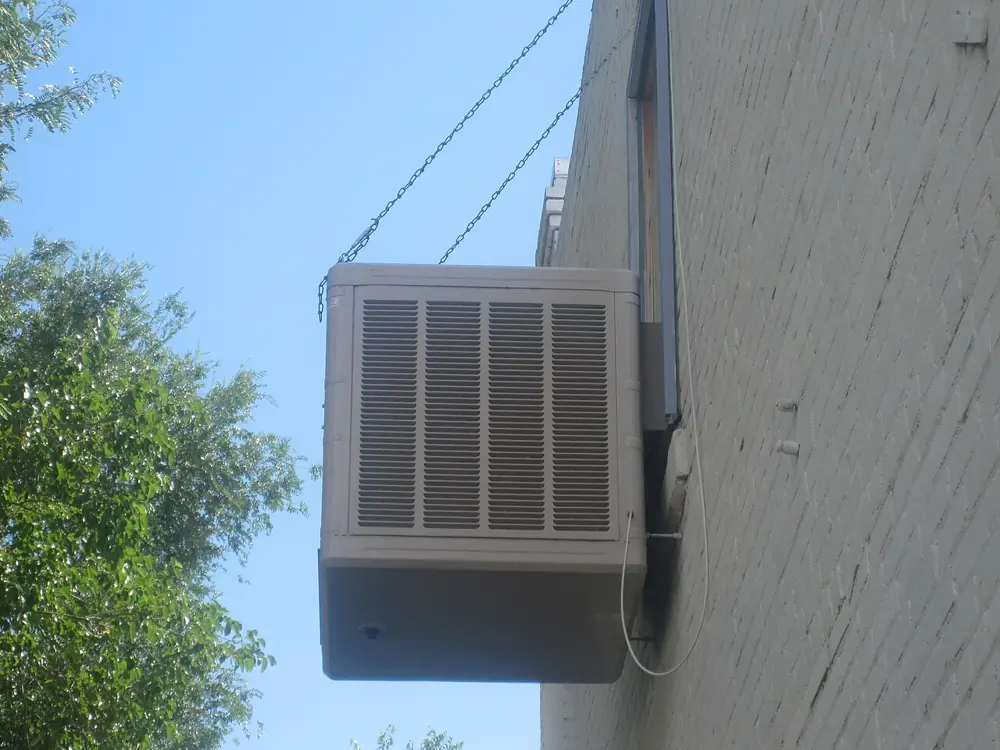
Source: Evaporative cooler — Wikipedia
The Babolsar sums
According to Wikipedia’s climate table, drawn from NOAA data, Babolsar in July has an average high of about 30 °C and a dew point of about 22.3 °C. From these two numbers we calculated the wet-bulb temperature: about 24.6 °C on a July afternoon. So from the outset, it’s above the 22 °C ceiling recommended for evaporative cooling.
Now apply the 3-to-4-degree rule: the air coming out of the evaporative cooler is about 28 °C, and nearly saturated. The outdoor air was 30 °C. So two or three degrees cooler, with more moisture than before.
For comparison, we ran the same sum for dry air at 40 °C with a dew point of zero: the cooler’s output is about 21 °C. That’s the difference between the north and the desert.
| Air | Outdoor temperature | Approximate cooler output |
|---|---|---|
| Babolsar, July afternoon | 30 °C | About 28 °C, nearly saturated |
| Dry air (dew point 0) | 40 °C | About 21 °C |
Wikipedia says the same without numbers: as humidity rises, the temperature drop an evaporative cooler can deliver falls, and the moisture it adds limits its use where the air is already humid.
Sources: Babolsar — Wikipedia (NOAA data, 1991–2020 normals); Evaporative cooler — Wikipedia. The wet-bulb temperature and cooler output are our own calculation.
Why does a refrigerant air conditioner do two jobs in the north?
A refrigerant air conditioner, whether a split or a ducted split, passes air over a very cold coil. Moisture in the air condenses on the coil and leaves as water; the water dripping from the AC’s drain hose. Wikipedia says an air conditioner designed for an occupied space typically brings the room to 30 to 60 percent relative humidity.
So in the north, an air conditioner both cools and dries the air. And in muggy air, part of the feeling of coolness comes from that drying.
Source: Air conditioning — Wikipedia
When do you need a dehumidifier?
Wikipedia puts suitable indoor relative humidity at 30 to 50 percent, and says high humidity brings mould, musty smells, warped furniture and sticking doors. Babolsar’s average summer humidity, per the same climate table, is about 76 percent.
Interestingly, refrigerant dehumidifiers work well in exactly these conditions. Wikipedia says they’re most efficient above 20 °C and 45 percent humidity. So for spring and autumn in the north, for stores and basements, or on days that aren’t hot but are damp, a dehumidifier is a real option. We covered mould and condensation in detail in humidity, mould and condensation.
Source: Dehumidifier — Wikipedia
A few points from us architects
Reduce the load first, then buy the machine. Shading, roof overhangs, the right windows and natural ventilation cut much of the cooling load before any AC switches on. We explained why overhangs matter in the north in pitched or flat roof, and window choice in UPVC or aluminium windows.
Put the AC in the plan from the start. The condensate drain must go somewhere proper, not down the facade. The outdoor unit needs space, shade and access for servicing.
With a heat pump, you may not need a separate AC. A heat pump is an air conditioner that runs in reverse in winter; we explained why it suits the north’s mild winter in heating a northern villa.
Summary, side by side
| System | In a northern summer | Humidity |
|---|---|---|
| Evaporative cooler | Two or three degrees cooler | Adds it |
| Refrigerant AC (split, ducted split) | Cools | Removes it |
| Dehumidifier | Doesn’t cool | Removes it; for shoulder seasons and damp spaces |
If you’re designing a villa in Babol, Babolsar, Sarkhorud, Amol or Sari and want summers that aren’t muggy, let’s work it out from the plan.


No comments yet. Be the first.