

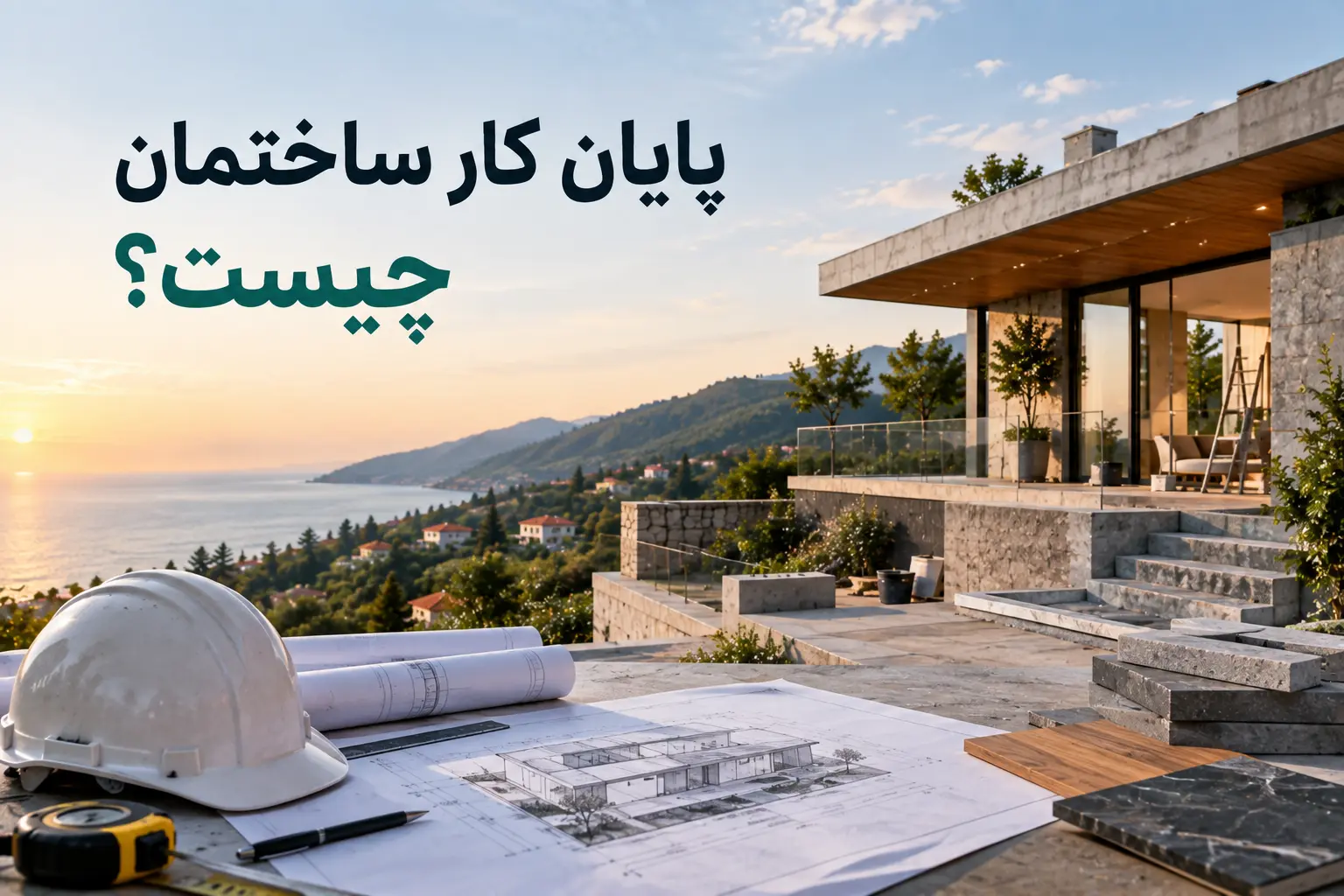
The building is finished, the facade is done, the keys are in your hand. As far as you are concerned, the job is over. As far as the law is concerned, not yet.
Until a completion certificate (پایان کار) is issued, your building is one step short — and that step shows up exactly when you least expect it: the day you want to sell it, divide it, or pass it on.
One line of law that explains everything
Note 8 of Article 100 of the Municipalities Act is explicit:
“Notary offices are obliged, before executing a final transaction concerning buildings, to examine the building completion certificate — and, for unfinished buildings, the certificate of no violation up to the date of the transaction — issued by the municipality, and to record this in the deed.”
Source: Municipalities Act — Article 100, Note 8 (as amended 1979)
So the notary is obliged to see the completion certificate before registering a final sale, and to record it in the deed. It is not the notary’s discretion; it is a legal duty.
What exactly a completion certificate is
The completion certificate is issued after all construction work is finished, at the request of the owner or their legal representative. It depends on two things:
- Approval by the supervising engineers — who, under Note 7 of the same Article 100, must supervise the building’s conformity with its permit.
- The building’s technical and property record (شناسنامه فنی و ملکی) — issued by the Construction Engineering Organisation, recording the building’s technical and ownership data and its compliance with the National Building Regulations.
Source: Ekhtebar — the completion certificate and how to obtain it
City or village?
The same distinction we drew in the building permit article applies here: the completion certificate is issued by the same authority that issued the permit. In a city, the municipality; in a village with a dehyari and a Hadi plan, the dehyari — as provincial guidance titled “how building permits and completion certificates are issued in villages by dehyaris” sets out.
Source: Issuing building permits and completion certificates in villages by dehyaris
What you lose without it
| What you want to do | Without a completion certificate |
|---|---|
| Final sale of the villa at a notary | Under Note 8 of Article 100 the notary must see the completion certificate (or, for an unfinished building, the certificate of no violation) |
| Dividing units and obtaining separate deeds | The subdivision record and separate title deeds are prepared on the basis of the completion certificate |
| Official record of the property’s use | The use is established and recorded through the same process |
Sources: Municipalities Act, Article 100, Note 8; Ekhtebar — uses of the completion certificate
For a villa only your own family lives in, these may seem distant today. But every property sooner or later takes one of these three routes: it is sold, divided, or inherited.
If you are buying an existing villa
This is the most important section for buyers: see the villa’s completion certificate before paying any deposit.
If the building has none, ask why. Sometimes the owner simply never followed it up; sometimes the building does not match its permit and its file has to go to the Article 100 Commission. For you, those two are worlds apart in risk — and finding out before purchase is far cheaper than after.
Add it to the pre-purchase checklist: for land, the zoning and land-use enquiry; for a building, the completion certificate.
The completion certificate starts on day one
Most people who get stuck at this stage did not create the problem on the last day; they created it months earlier, on site. The completion certificate is in effect a certificate that the building that was built is the building that was permitted. Any gap between the two shows up here:
- Extra floor area, an extra storey, a change of use — anything built beyond or different from the permit is seen when the certificate is requested and, under Article 100, must be referred to the commission.
- A supervisor who only signs — Note 7 of Article 100 obliges the supervisor to oversee the building’s conformity with its permit. A supervisor who was not present during the works cannot confidently approve at the end.
- Changes made “on site” — decisions taken during construction and recorded nowhere. Coordinate and document every change with the supervising engineer and the permit authority before carrying it out.
This is where choosing the designer and supervisor matters — the subject of how to choose a good architecture firm. A design built to the zone’s rules from the start gets stuck far less at the end.
Take the permit deadline seriously
Note 2 of Article 29 of the Urban Renewal and Development Act requires the building permit to state “the maximum period necessary for completing the building”. The same note doubles the renewal levy for buildings on main squares and streets that remain unfinished two years after that period — and doubles it again for every further two years.
Source: Urban Renewal and Development Act — Article 29, Note 2
A point often stated wrongly: the law itself does not fix a construction period. Your permit does. Rather than relying on commonly quoted figures, check the period written on your own permit.
The general route
Details vary between municipalities and village administrations, but the general route is:
- All construction work finished — not “nearly finished”.
- Report and approval from the supervising engineers.
- Issue of the technical and property record by the Construction Engineering Organisation.
- Application by the owner or their legal representative to the authority that issued the permit.
- Inspection for conformity with the permit — and resolution of any discrepancy before issue.
- Issue of the completion certificate.
The fuller sequence, from design through construction, is in the villa design and construction process.
Some honest caveats
Procedures are local. The exact documents, fees and order of steps differ between municipalities and village administrations; get the final list from the authority that issued your permit.
Laws change. This text rests on the provisions cited; check they remain current before acting.
This is not legal advice. If your building does not match its permit or its file is before a commission, consult a lawyer.
In short
The completion certificate is not a paper you collect at the end; it is the result of the whole construction process. Built to the permit from day one, with a supervisor who genuinely supervises, it is a simple formality. Otherwise, every gap is accounted for at once, right there.
If you have a villa ahead of you in Babol, Babolsar or Sarkhorud and want the road to completion to be smooth from the design stage, get in touch.

No comments yet. Be the first.