

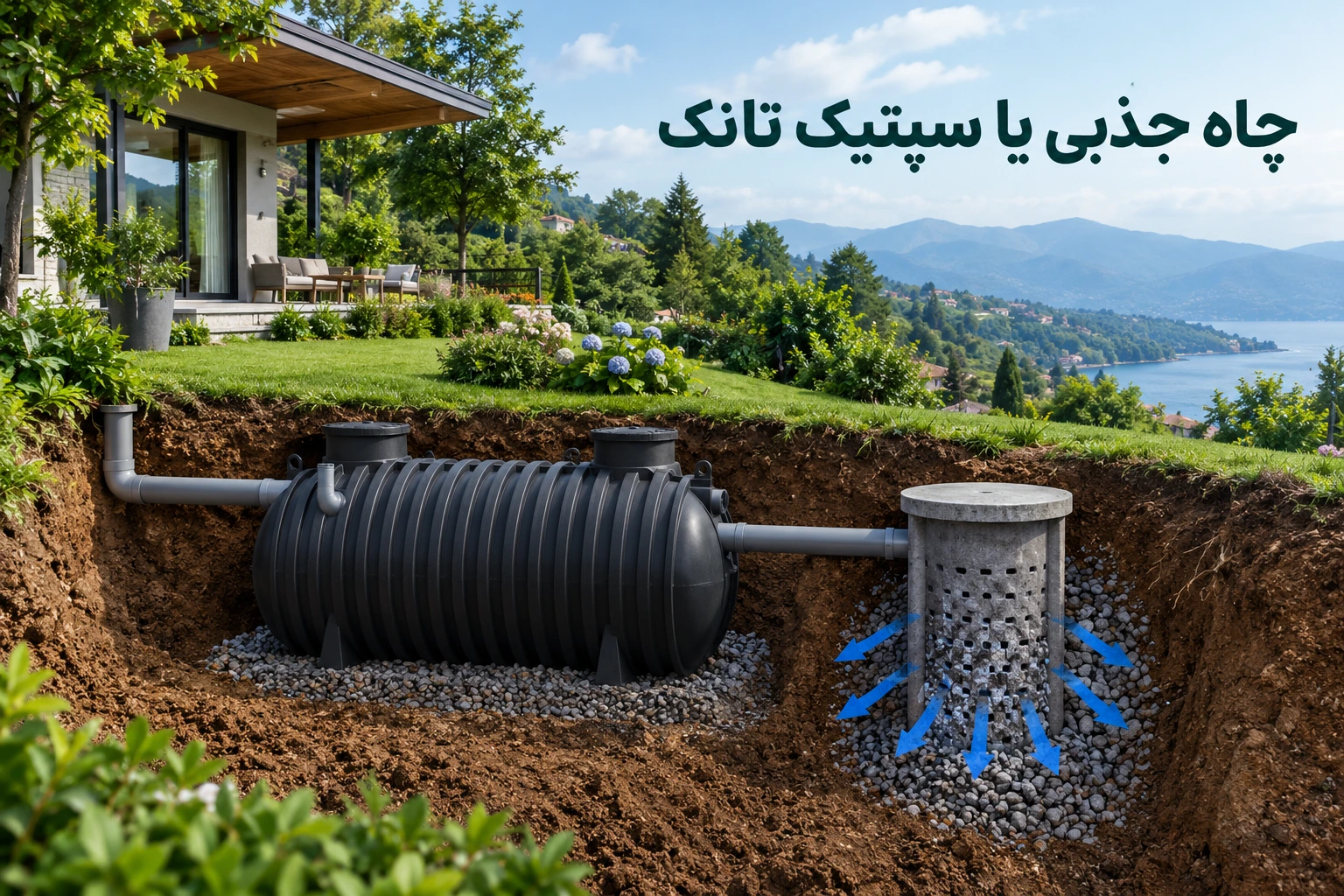
In 2003, a homeowner in far north Queensland, Australia, got approval to put a septic tank on their land. The approval had a clear condition: there had to be 1.2 metres of dry soil between the bottom of the absorption bed and the groundwater. When the local council’s inspector came by, the gap was only 75 centimetres. According to an independent soil investigation, the land had a high water table in the wet season.
It went to the building tribunal, and the decision was clear: the council’s enforcement notice was confirmed, and the owner had twenty business days to put it right. Over 45 centimetres.
Why would a local government be so strict about 45 centimetres? And what does it have to do with our villa in Babolsar? More than you might think.
Source: Queensland Building and Development Tribunal — Appeal 03-05-074
First, where we stand
In April–May 2026, Mazandaran’s governor said the national average for access to sewerage services is about 57%, and in Mazandaran only 23%. He gave another figure at the same time: about 82% of the province’s drinking water comes from groundwater.
Put those two numbers side by side. Most houses and villas still dispose of their own wastewater, on their own land — and that same ground is the source of the water most of the province drinks.
Source: Jam-e Jam Online, 3 May 2026 — remarks by the governor of Mazandaran (in Persian)
Soil is a free treatment plant — but only when it’s dry
Disposing of wastewater into the ground isn’t a bad idea in itself, on one condition. The US Environmental Protection Agency (EPA) explains that the part that absorbs the wastewater, the drainfield, must be built in unsaturated soil — soil with air between its grains, not water. As wastewater passes through it, the soil removes bacteria, viruses and nutrients, and cleaner water then reaches the groundwater.
In other words, that layer of dry soil is the treatment plant. The 1.2 metres the Queensland council wouldn’t budge on is the thickness of that plant. According to the same case file, the joint Australian/New Zealand standard (AS/NZS 1547) also prefers a seasonal water table deeper than 1.2 metres.
The EPA has another warning: if the drainfield takes more water than it can handle and floods, wastewater either comes up to the surface or backs up into the house’s plumbing.
Source: EPA — How Your Septic System Works
Now do the sums for Daryakenar
A study of groundwater around Babol and Babolsar found that in the coastal area of Daryakenar, the water table is less than two metres below the surface, and that it rose and fell by more than a metre over the study period.
Now picture an ordinary absorption well going several metres into the ground. On land like this, the bottom of the well isn’t 1.2 metres above the groundwater — it’s in it. There’s no soil left to treat anything; the wastewater goes straight into the same water the province draws from underground. And in the rainy season, when the water rises, the EPA’s scenario plays out: the well fills and the wastewater has nowhere to go but up.
We covered why the water table in the north is so high, and how it fluctuates, in high groundwater and building foundations.
Source: Yousefi Roshan & Lorestan, groundwater fluctuations in Babol–Babolsar (in Persian)
A septic tank is half the job, not the whole job
Many people see a septic tank as the alternative to an absorption well. But a septic tank doesn’t “dispose” of anything; it’s only the first stage. It’s a sealed tank where wastewater settles: heavy solids sink and form sludge, grease and light material float up as a layer of scum, and the liquid in the middle leaves through the outlet.
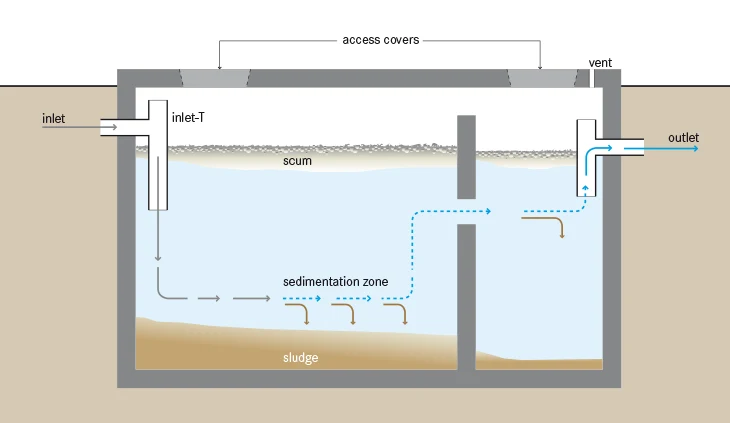 Cross-section of a two-chamber septic tank. Sludge settles, scum stays on top, and only the liquid in between reaches the outlet. That liquid is still wastewater and has to be treated somewhere. Image: Tilley et al., Compendium of Sanitation Systems — Wikimedia Commons, CC BY-SA 4.0
That outflow still needs treating somewhere. In a conventional system, that “somewhere” is the drainfield in dry soil — so Daryakenar’s problem stays exactly where it was with a septic tank too, if an absorption well comes after it.
A septic tank also needs looking after. The EPA says a household system should be inspected at least every three years, and the tank is typically pumped every three to five years. You shouldn’t park or drive on the drainfield, and roof drains and rainwater should be kept away from it — something that matters from the day the garden is designed, in the rainy north.
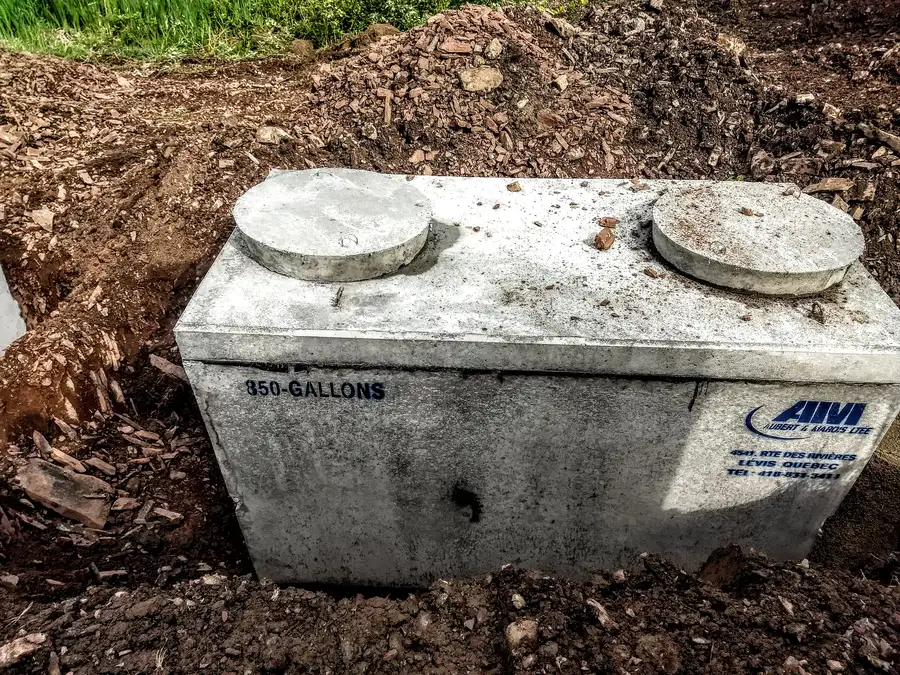 A precast concrete septic tank of about 3.8 m³, before the pipes are connected and the pit backfilled. The two lids on top are for inspection and pumping, so it has to sit where a pump truck can reach it. Photo: Nonztp — Wikimedia Commons, CC BY-SA 4.0 (resized)
Source: EPA — How to Care for Your Septic System
So what should a villa owner do?
The answer differs from plot to plot, but the order of thinking is the same:
First, check whether there’s a municipal sewer network, or one on the way. If there is, it’s the best option: the wastewater leaves your land and your groundwater altogether. Networks are expanding, too: according to the same report by the governor, Babolsar’s treatment plant is due to grow from 6,000 to 16,000 cubic metres a day, serving about 85,000 people.
If there isn’t, find out how deep the water table is — and measure it in the rainy season. A figure taken in summer can be misleading, given Daryakenar’s fluctuation of more than a metre. It’s the same soil investigation you need for the foundations anyway; do it once and use it twice.
Then design the system for that number, not for local habit. Where there isn’t enough dry soil left between the bottom of the system and the groundwater, a deep absorption well is the worst choice. The solution has to come from treating the wastewater more before it reaches the soil, or from keeping it entirely away from the groundwater. The exact choice, and what the local municipality or village council requires, is a building-services engineer’s job; the Australian and American rules quoted here show the logic, they don’t replace Iranian regulations.
And place it on the drawings from day one. A tank the pump truck can’t reach, a drainfield that ends up under the parking area, or a downpipe that empties the roof straight onto the absorption area — all are mistakes that cost a lot to fix once the house is built.
Three numbers worth remembering
- 23%: Mazandaran’s access to sewerage services — so your villa’s wastewater is most likely your own responsibility.
- Under 2 metres: the depth of the water table in Daryakenar — so an absorption well there sits in the water.
- 1.2 metres: the dry soil Queensland’s rules require between wastewater and groundwater — the thickness of the treatment plant nature gives us for free.
Sewage isn’t the most exciting part of designing a villa, but it’s one of those parts that, if it isn’t thought through from the start, you can smell for years. If you’re building a villa in Babolsar, Sarkhorud or Babol and want this part planned properly from day one, talk to us.





No comments yet. Be the first.