
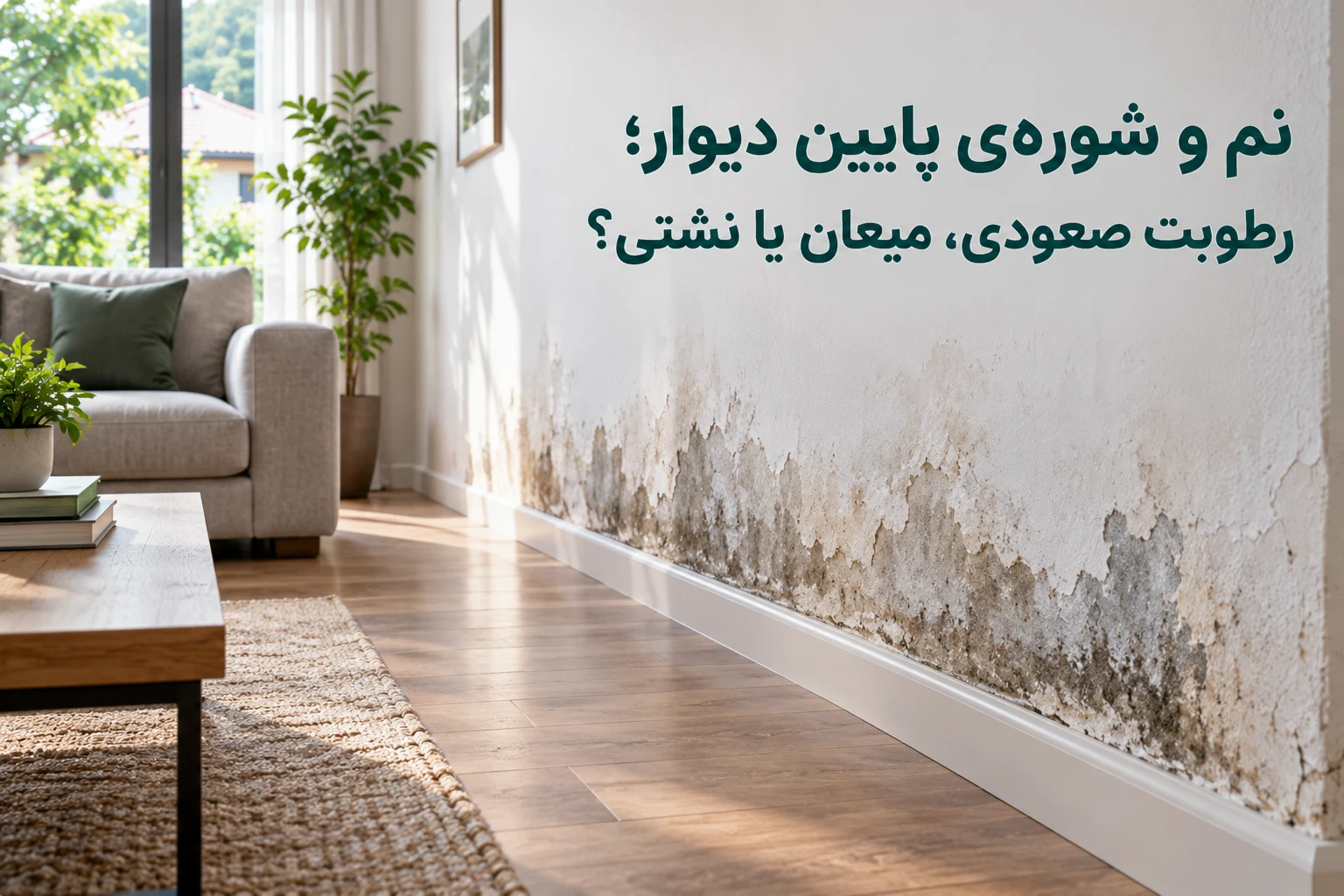
At the bottom of the wall, just above the skirting, the paint has blistered and flaked off in a few places. Usually the first thing you hear when someone sees it is: “The damp’s coming up from the ground.” It may be true. But before you spend money on that diagnosis, know one sentence from the UK government’s official guidance on damp and mould: rising damp is “often misdiagnosed”. The same guidance names something else as the most common form of damp: condensation.
So the same stain at the bottom of the wall can come from three quite different places, and each has a different cure. Get the source wrong and you either pay for work that doesn’t solve the problem, or cover the stain only to see it back a few months later.
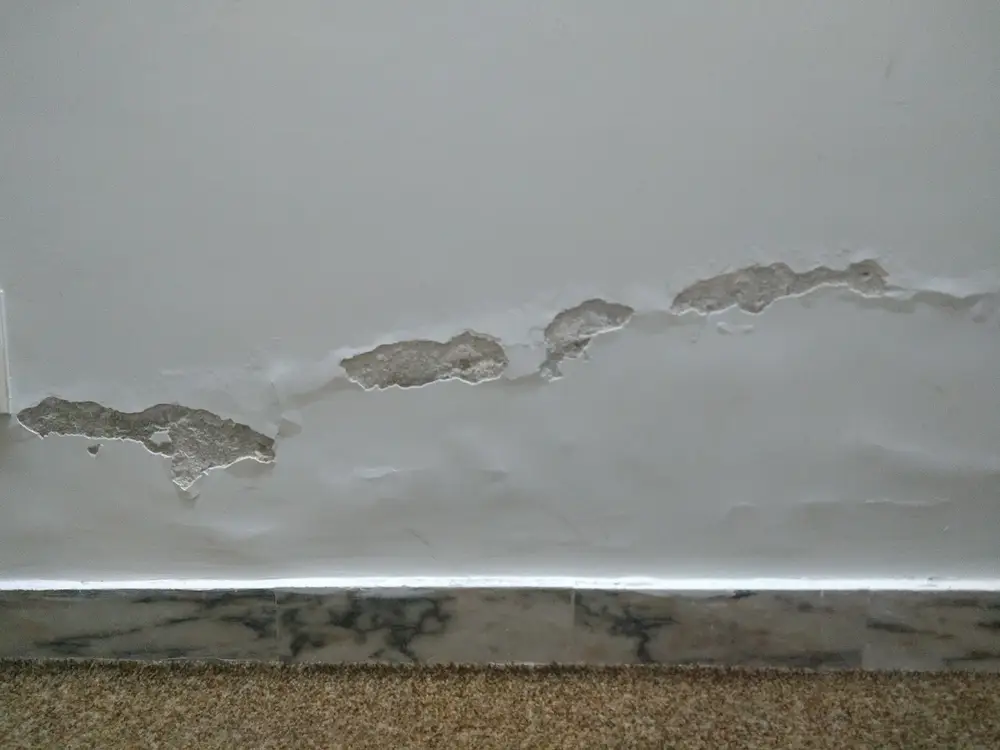
Source: GOV.UK — Understanding and addressing the health risks of damp and mould in the home (2026)
Three suspects, three different signatures
Rising damp: from below, through the pores
This is moisture drawn up from the ground through the pores of brick, mortar and concrete, like oil climbing a lamp wick. Wikipedia gives two clear signs. One is height: it’s usually much lower and rarely goes above 1.5 metres. The other is a wavy line on the wall called a “tide mark”: soluble salts in the water, such as nitrates and chlorides, collect right where the water reaches its highest point and evaporates, leaving a distinct band.
Penetrating damp: from outside, through a defect
This is water entering the building from outside through a defect in a wall, roof, window or floor. Window reveals are a common spot. Its main sign is its link to rain: it gets worse after heavy rain, and it usually has a specific spot you can trace.
Condensation: from inside the house, on a cold surface
This is moisture we produce indoors — from cooking, showers and breathing — that turns to water when it meets a colder surface. Its usual places are the kitchen, the bathroom and the cold spots in walls: the thermal bridges we covered in detail in humidity, mould and condensation in northern villas.
There’s a fourth suspect, too, the one most often overlooked: a leaking pipe in the wall or floor. It has nothing to do with rain or season; it’s always there.
Sources: Damp (structural) — Wikipedia; GOV.UK — Damp and mould
Reading the signs
| Sign | Most likely | Why |
|---|---|---|
| A wavy band and salts, usually below 1.5 m | Rising damp | Salts collect where the water evaporates |
| A stain that grows after rain | Penetrating damp | Water comes from outside, through a defect |
| Black mould in corners, behind wardrobes, at window reveals | Condensation | Cold surface, humid indoor air |
| Worse in winter and after showers and cooking | Condensation | Warm humid air, cold wall |
| A constant stain along a pipe run, regardless of season | Leaking pipe | The water is always there |
This table doesn’t replace an expert inspection, since one wall can have two of these at once. But it helps you ask the right question.
Salts don’t always mean rising damp
The white powder that settles on brick or plaster is salt that water carried in and left behind when it evaporated. So salt means “water has passed through here”, not necessarily “water came from the ground”. Wikipedia names another source of salt that coastal towns should take seriously: unwashed sea sand used in mortar or plaster. In that case the salts may come from the materials themselves, not from moisture that is still rising.
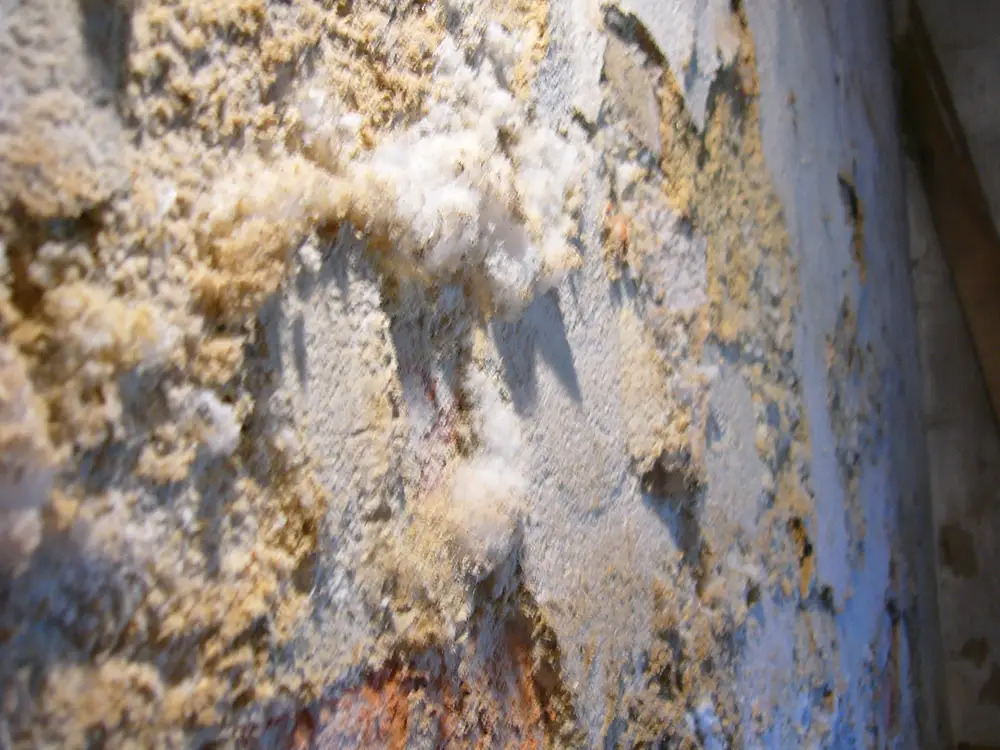
Source: Damp (structural) — Wikipedia
Three places money usually goes to waste
1. Trusting the moisture meter’s number. Common electrical moisture meters were made for timber. Wikipedia says plainly that they can’t accurately measure the moisture content of masonry. The pattern of readings — where on the wall they’re higher — can be a clue; the number itself isn’t a diagnosis.
2. Covering up instead of finding the source. Anti-mould paint, new wallpaper or a coat of plaster hides the stain for a few months. The UK government guidance is clear here too: simply removing surface mould won’t stop damp and mould coming back; the underlying cause has to be found and fixed. And it isn’t just about looks — the same guidance says damp and mould mainly affect the airways and lungs.
3. Buying a rising-damp cure for condensation. If the problem is really condensation, injecting a damp-proof course into the base of the wall does nothing, because the water isn’t coming from the ground. Electrical anti-damp (electro-osmotic) systems are a separate story: according to Wikipedia, the UK’s Building Research Establishment (BRE) says their effectiveness hasn’t been demonstrated in the laboratory and field evidence has been disappointing.
Sources: Damp (structural) — Wikipedia; GOV.UK — Damp and mould
If it really is rising damp
First, make sure. The UK government guidance says rising damp can be identified by visual inspection, but that chemical testing is the most appropriate way of confirming it. The method BRE prefers, according to Wikipedia, is drilling out mortar samples and measuring their moisture and salt content in a lab. It’s destructive, but it gives a real answer.
Then the cure. According to Wikipedia, the most common method is injecting a water-repellent liquid or cream into the brick or mortar at the base of the wall. The other is inserting a physical damp-proof layer into the wall, which is very effective but expensive and needs an experienced contractor.
And if the building isn’t built yet, this is where prevention is far cheaper than cure. Internationally this layer is called a damp-proof course (DPC): an impermeable layer — slate, bitumen felt, metal or plastic — bedded in the mortar between two courses of bricks. Wikipedia says that in outer walls it normally sits 150–200 mm above ground level; in other words, above the garden soil.
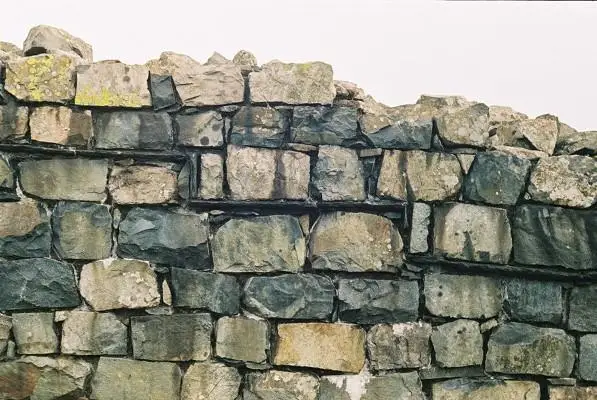
In the north, both sides of the story are serious. On one hand, the water table on the coastal strip is high; one study put it at less than two metres below ground in Daryakenar, as we explained in high groundwater and building foundations. On the other, Babolsar’s air averages 80% humidity a year, which keeps condensation close at hand too. So in a northern villa, the odds of dealing with more than one of these suspects aren’t small.
Sources: Damp proofing — Wikipedia; Damp (structural) — Wikipedia; Yousefi Roshan & Lorestan, groundwater fluctuations in Babol–Babolsar (in Persian); Babolsar — Wikipedia (NOAA data)
The right order
- First ask where the water comes from: the ground, outside, the indoor air, or a pipe.
- Then confirm it: with an inspection by someone who checks all four possibilities, and with testing if rising damp is in the frame.
- Only then treat it: close off the source first, then turn to plaster and paint.
If you have a villa in Babolsar, Sarkhorud or Babol with a damp wall, or you’re building one and want to stop this from day one, get in touch.