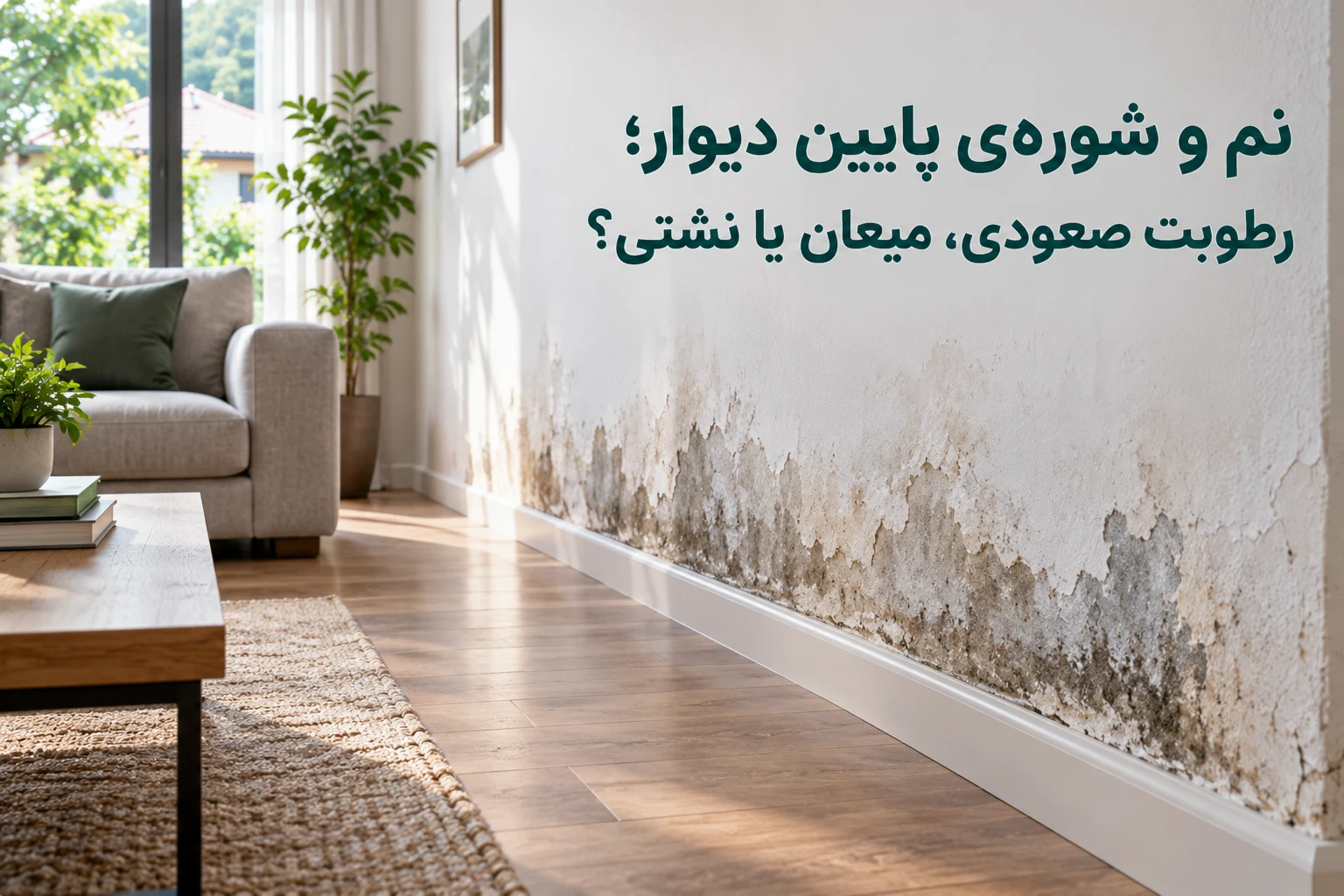

There’s one number worth knowing before you choose the floors for a villa in the north: relative humidity in Babolsar never drops below 75% in any month of the year. The lowest is June at 75%, the highest December at 84%, and the yearly average is 80%.
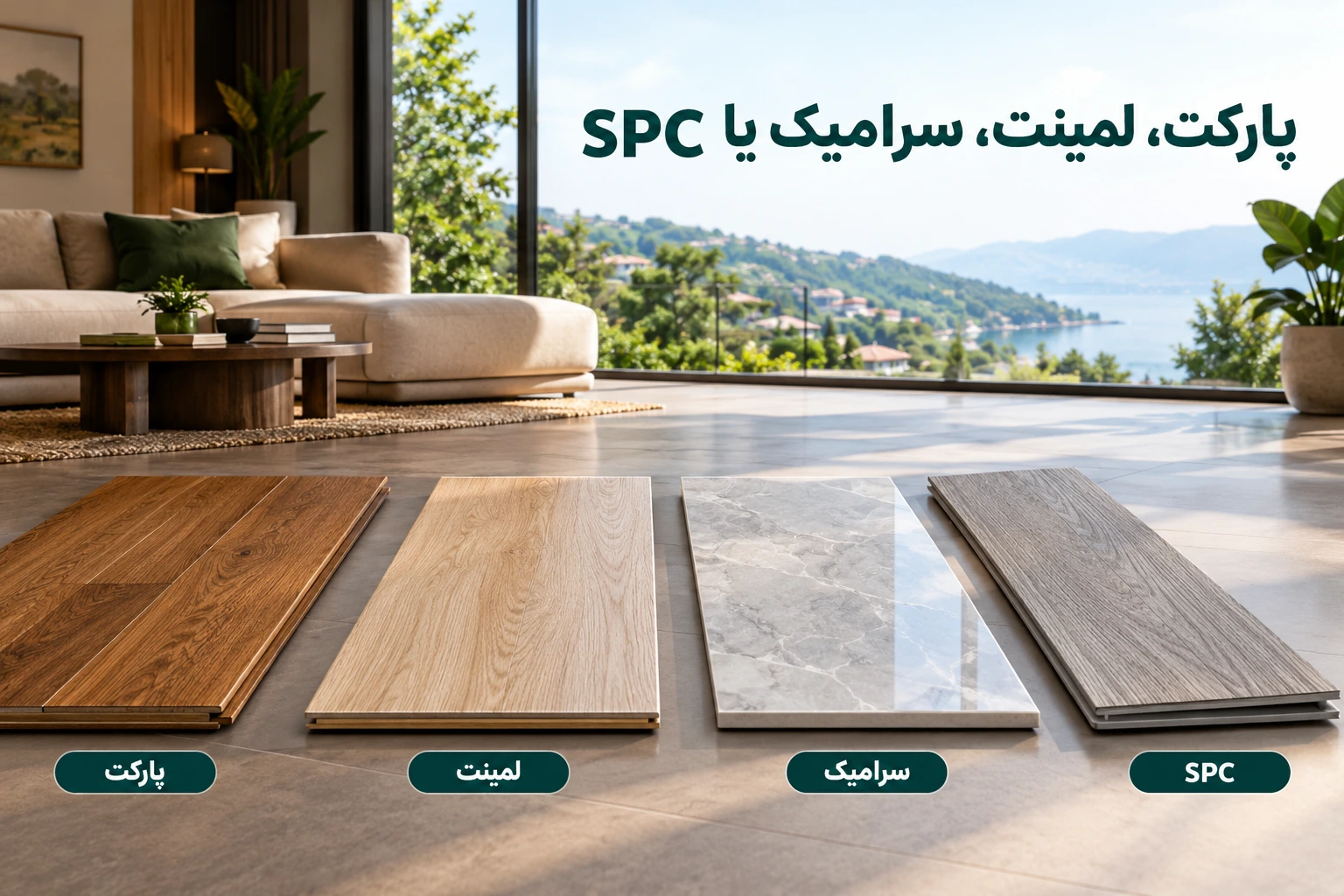
That number goes straight to a question many people ask when building or renovating a villa: should we lay solid parquet? Does laminate swell in the north? Isn’t tile too cold? And what is this SPC everyone talks about? Let’s go through them one by one, with numbers.
Source: Babolsar — Wikipedia (NOAA data, 1991–2020)
Wood breathes with the air
Wood, even after it’s cut, dried and finished, keeps exchanging moisture with the air around it. Whatever the humidity of the air, the wood eventually settles at a particular moisture content and stays there. That figure is called the “equilibrium moisture content”, and there’s a well-known formula for it, the Hailwood–Horrobin equation.
We ran that formula for 20°C:
| Air humidity | Wood moisture | Where |
|---|---|---|
| 40–45% | about 8% | A house heated in winter |
| 75% | about 14.5% | Babolsar’s least humid month |
| 84% | about 17.6% | Babolsar air in December |
So parquet sitting at 8% in a warm, dry house can take on about twice that if the villa stays closed for a few weeks and the outside air gets in.
Source: Equilibrium moisture content — Wikipedia (Hailwood–Horrobin equation)
So how much does it swell?
The magazine of the US National Wood Flooring Association (NWFA) gives a simple calculation: multiply the change in moisture by the coefficient for that species, then by the board width. It gives the coefficient for red oak: 0.00369.
The formula holds mainly between 6% and 14% moisture, so we only calculated up to 14%, not to winter’s 17.6%. A 15 cm oak board going from 8% to 14%:
6 × 0.00369 × 150 mm ≈ 3.3 mm wider.
A small number — until you remember a 4-metre room holds about 27 of those boards. On paper, the whole floor wants to grow by about 9 cm. The same magazine fairly adds that in an installed floor the boards press against each other and actual movement is less than the calculation. But when wood has nowhere to go, the pressure shows up somewhere else.
Wikipedia names the signs: cupping, where the long edges rise and the middle dips; crowning, where the middle bulges as humidity rises; and gapping, where spaces open between boards as they dry again. According to the same source, solid wood is more prone to these than engineered wood.
Sources: Hardwood Floors Magazine (NWFA) — Determining Dimensional Stability in Wood; Wood flooring — Wikipedia
Engineered wood: the same wood, with one simple trick
Engineered wood is made of several layers of wood glued together, and the trick is that each layer runs at 90 degrees to the one above it. Each layer wants to swell one way, and the next layer holds it back. The result, according to Wikipedia, is greater stability than solid wood.
There’s another important difference: engineered wood can go over underfloor heating, while the same source says plainly that solid wood should not be used with underfloor heating. If your villa has, or will have, underfloor heating, that sentence largely settles it.
Source: Wood flooring — Wikipedia
Laminate: the look of wood, a core of wood fibre
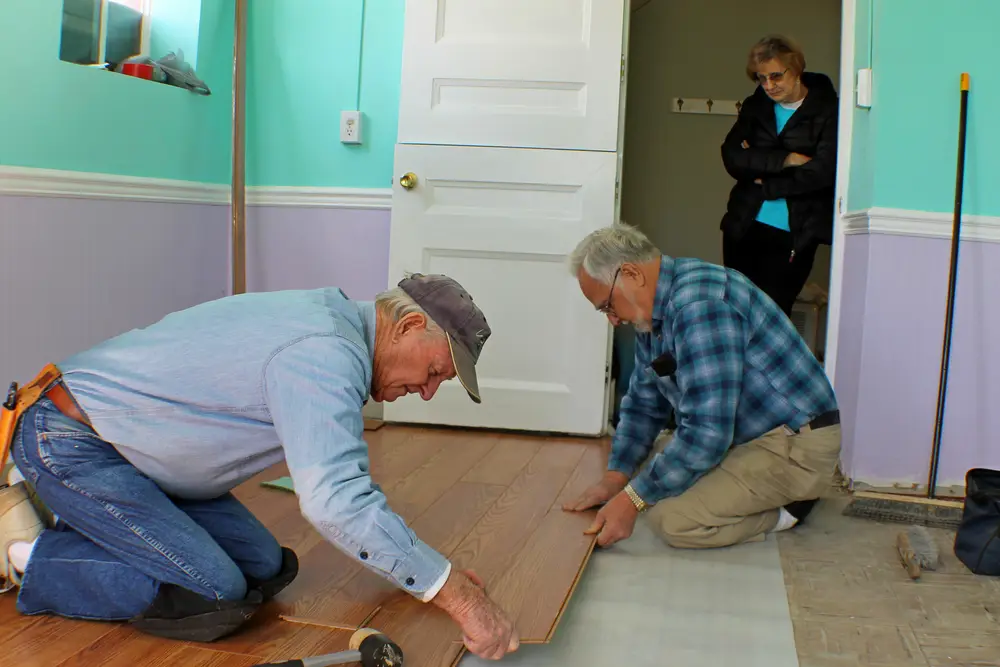
Laminate isn’t wood; it’s a picture of wood bonded to a core of compressed wood fibre and melamine resin. The look may fool you, but the core is still wood-based and doesn’t get along with water. Wikipedia says plainly that water or moisture left sitting on laminate can make the planks swell and warp. The fact that there’s a separate international standard (ISO 24336) just for measuring how much laminate “swells” after being immersed in water shows how real the issue is.
That’s why laminate is laid with a 1–10 mm gap from the walls to leave room for expansion, over an underlayment that reduces both sound and moisture from below.
Sources: Laminate flooring — Wikipedia; ISO 24336:2005
Ceramic and porcelain: water doesn’t bother them
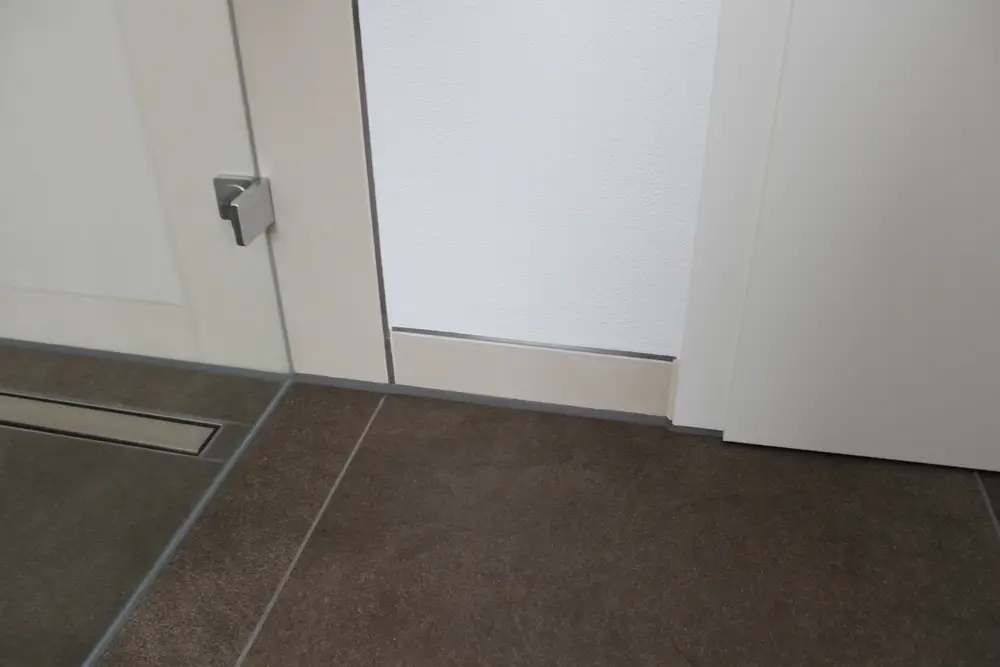
Porcelain, according to Wikipedia, is a dense, vitrified tile that absorbs less than 0.5% water, and it’s frost-resistant too. Its current standards are ISO 13006 and EN 14411. Northern humidity, bathroom water or mud carried in from the garden make almost no difference to it.
Its two well-known drawbacks are real. One is the cold feel underfoot, which underfloor heating effectively solves. The other is slipperiness when wet; for bathrooms, entrances and terraces you need an anti-slip surface. Wikipedia mentions exactly these anti-slip finishes for “wet or outdoor environments”.
Source: Porcelain tile — Wikipedia
SPC: the newcomer everyone asks about
SPC is a vinyl floor that looks like laminate, but its core is fundamentally different. According to the trade publication Floor Focus, an SPC core contains up to 75% limestone, with PVC and no foaming agents. So unlike laminate, there’s no wood fibre in the core to soak up water. The same source describes it as waterproof and more resistant to impact and dents.
Two fair points: a “waterproof” plank doesn’t mean water can’t get under it through the joints, and a floor that stays wet underneath dries slowly. And it’s a plastic product, with a feel and look different from real wood. So where there’s moisture and wetness, it’s a sensible choice; for someone who wants the feel of wood, perhaps not.
Source: Floor Focus / FloorDaily — LVT Evolution: WPC and SPC (2017)
Which space, which floor
| Space | Sensible choice | Why |
|---|---|---|
| Bathroom and WC | Tile or porcelain, anti-slip | Water reaches the floor directly |
| Kitchen | Porcelain or SPC | Spills every day |
| Entrance and terrace | Anti-slip porcelain | Mud, rain and wet shoes |
| Living room and bedrooms, villa lived in year-round | Engineered wood, SPC or good laminate | Humidity controlled by heating and AC |
| Villa closed for months | Porcelain or SPC | Humidity climbs unchecked to 80% |
| Anywhere with underfloor heating | Porcelain or engineered wood, not solid wood | Solid wood doesn’t suit underfloor heating |
More important than the floor: indoor humidity
All the sums above carried a hidden assumption: that indoor humidity equals outdoor humidity. It doesn’t have to. The US Environmental Protection Agency (EPA) recommends keeping indoor humidity below 60%, ideally between 30 and 50%. In that range, by the same formula, wood sits at about 6–9% moisture and stays calm.
So if the villa has proper ventilation and a well-sized dehumidifier, you have far more freedom in choosing floors. If not, whatever the floor, it’s the first place a humidity problem shows itself. We covered indoor humidity in humidity, mould and condensation in northern villas, and the cold-season routine in winter care for an empty villa.
Source: EPA — A Brief Guide to Mold, Moisture and Your Home
The floor is the part of a villa you deal with every day. If you’re building or renovating a villa in Babolsar, Sarkhorud or Babol and want each room’s floor to suit its use and its air, let’s choose it together.