


“Which insulation is best?” is one of those questions where the person answering often has something to sell. Rock wool’s advocates usually talk about fire, EPS’s about lightness and price, XPS’s about water. And interestingly, each of them is telling part of the truth.
So instead of “which is best”, let’s ask three separate questions: how well does it hold heat? What does it do with water? What happens in a fire? And there’s one place where even the industries themselves haven’t agreed.
Question one: heat
The measure is “thermal conductivity”: the lower, the better the insulation. According to Wikipedia:
| Insulation | Thermal conductivity (W/m·K) | Note |
|---|---|---|
| EPS (expanded polystyrene) | 0.032–0.038 | Depends on density |
| XPS | 0.029–0.039 | Average about 0.035 |
| Mineral wool (rock wool) | 0.030–0.045 | Depends on type and density |
These ranges overlap a great deal. So on paper, for heat alone, the three are roughly level, and the difference between two products of the same type is sometimes bigger than the difference between types. If someone prefers one over another purely on its “insulation number”, they’re telling half the story. Thickness, and installing the insulation continuously without gaps, matter far more than these small differences.
Sources: Polystyrene — Wikipedia; Mineral wool — Wikipedia
Question two: water
This is where the north comes in. Babolsar’s air averages 80% relative humidity a year, and insulation that gets wet is no longer good insulation.
Mineral wool, according to Wikipedia, clumps and loses effectiveness when moist or wet; but it doesn’t absorb much moisture itself, and it regains its effectiveness once dried. So its enemy is trapped water, not passing humid air.
EPS and XPS are both closed-cell foams, and many people assume that means water can’t get in. But Wikipedia says plainly that neither is entirely waterproof or vapour-proof, and that polystyrene foams commonly become waterlogged over long periods.
Sources: Building insulation material — Wikipedia; Polystyrene — Wikipedia; Babolsar — Wikipedia (NOAA data)
Below ground: where two industries gave opposite answers
Insulating basement walls and under foundations is the hardest job: it’s in constant contact with damp soil and sometimes groundwater, which is high on the northern coastal strip. This is where the story gets interesting.
An EPS manufacturer, in a technical bulletin (2016), accepts that in standard laboratory tests XPS absorbs less water than EPS. But it says those tests last only a few days, and then cites a field study: after 15 years below ground, XPS held about 19% water and EPS 5%, and XPS had kept only 52% of its original insulating value, against 94% for EPS.
Now the other side. The director of codes and standards for the XPS manufacturers’ association, writing in the trade journal The Construction Specifier (2020), cites a different field study in Alaska: after 31 years below ground, XPS still had about R-4.1 per inch, while EPS after 21 years had about R-2.2. His conclusion is that EPS needs to be 1.5 to 2 times thicker to match XPS.
Two field studies, two completely opposite results — each published by an industry that benefits from its result. We don’t dismiss either. But what neither side disputes is that insulation that sits in water for years loses performance. So the real question for a northern villa’s foundations isn’t “which brand” but where the water around the wall and under the slab goes. Proper drainage and free-draining backfill matter more than the choice between these two foams. We covered groundwater in detail in high groundwater and building foundations.
Sources: Halo — Technical Bulletin No.3: EPS vs XPS Water Absorption (2016, EPS manufacturer); The Construction Specifier — XPS delivers high R-values in below-grade applications (2020, XPS association)
Question three: fire
Here the differences are no longer small.
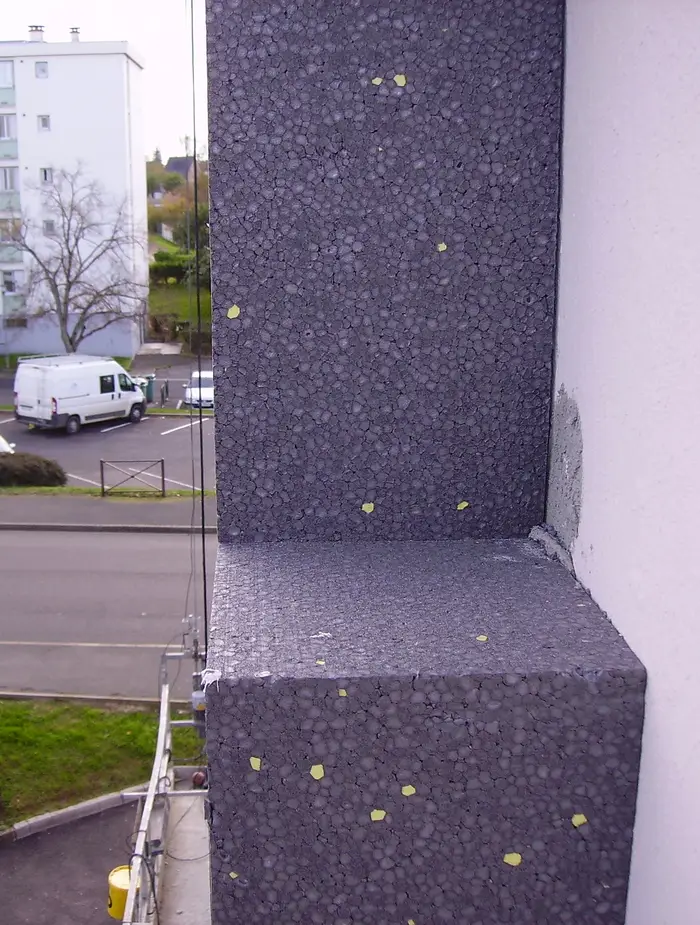
Polystyrene, whether EPS or XPS, is flammable according to Wikipedia and releases large amounts of black smoke when it burns. That’s why flame retardant is added to building-grade EPS. The same source says polystyrene foam must be concealed behind drywall, sheet metal or concrete, and a US code-evaluation body (ICC-ES) requires a 15-minute thermal barrier when EPS is used inside a building. Wikipedia has a heavier sentence too: polystyrene foams have been accidentally ignited and caused huge fires and loss of life. Most foams also release toxic fumes when they burn.
Mineral wool is non-flammable. According to Wikipedia’s table, stone wool withstands about 700–850°C, which is why it’s usually the choice where fire protection is needed.
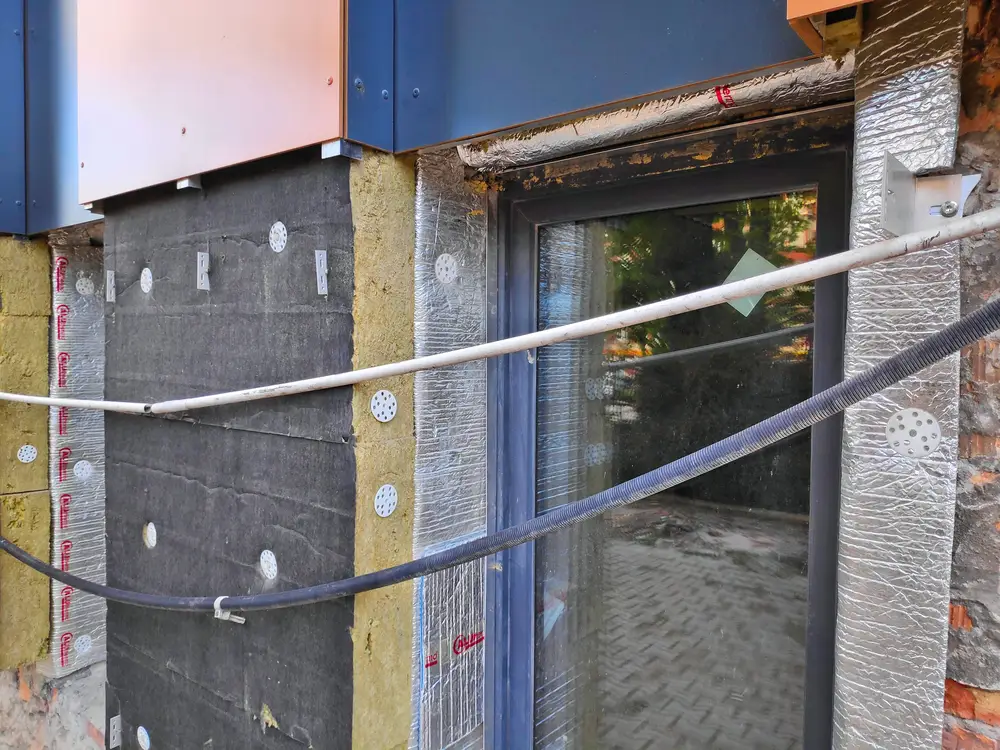
One fair note about mineral wool: during installation it irritates the eyes, skin and lungs, so it should be handled with gloves, a mask and goggles. The International Agency for Research on Cancer (IARC) places stone wool in Group 3, meaning “not classifiable as to carcinogenicity in humans”.
Sources: Polystyrene — Wikipedia; Mineral wool — Wikipedia; Building insulation material — Wikipedia
Where, what
| Location | Sensible choice | Why |
|---|---|---|
| Loft and roof | Rock wool | Non-flammable, and recovers once dried if it gets wet |
| Near a fireplace, chimney or kitchen | Rock wool | Near fire, non-flammability is decisive |
| External wall, under heavy cladding | Rock wool, or flame-retardant EPS fully covered | EPS must never be left exposed |
| Basement walls and under the foundation | XPS or EPS, with proper drainage | Here water matters more than the material |
Good insulation is dry insulation
If one sentence stays with you from this article, let it be this: in the north, where and how insulation is installed matters more than what it’s made of. Insulation that runs continuously, without gaps, outside the structure prevents thermal bridges and condensation — as we showed with numbers in humidity, mould and condensation in northern villas, and for light steel frames in LSF or concrete. And insulation with drained water around it keeps doing, for years, the job you paid for.
If you’re building a villa in Babolsar, Sarkhorud or Babol and want each part’s insulation to suit that part’s fire, water and air, let’s choose it together.



No comments yet. Be the first.