


When people talk about landscaping a villa, lawn, paving and lighting usually come to mind first. In the north, before all of that, there’s another question whose answer decides how many years the rest will last: where does the rainwater go?
First, the sums
According to NOAA data, Babolsar gets about 909 mm of rain a year, over roughly 71 rainy days. Its wettest month is November with 165 mm, and October and December aren’t far behind.
One millimetre of rain on one square metre is one litre of water. Now take an ordinary villa with 200 m² of roof and 150 m² of paved yard — 350 m² of surface that water can’t pass through:
| Period | Rainfall | Water running off these 350 m² |
|---|---|---|
| Whole year | 909 mm | about 318,000 litres |
| November alone | 165 mm | about 58,000 litres |
That water has to go somewhere. If you don’t give it a place, it finds one itself — and usually the first place it finds is the foot of the house wall.
Source: Babolsar — Wikipedia (NOAA data, 1991–2020); the water-volume calculation is ours.
Rule one: water away from the house
The US Environmental Protection Agency (EPA), in its guide to moisture and mould, has two simple sentences that underpin all landscaping in the north: clean and repair roof gutters regularly, and make sure the ground around the house slopes away from it, so water doesn’t enter or collect around the foundation.
That means paving around the building, beds planted against the wall, and even the soil backfilled around the house after construction should all lead water away from the building, not towards it. And a downpipe shouldn’t empty right at the foot of the wall. Otherwise the water you collected from the roof comes back to the wall from below — the damp we discussed in damp at the bottom of the wall.
If the villa has a septic tank, there’s one more point: the EPA says roof and rainwater should be kept away from the septic drainfield, and you shouldn’t park on it either. We covered villa wastewater in absorption well or septic tank.
Sources: EPA — A Brief Guide to Mold, Moisture and Your Home; EPA — How to Care for Your Septic System
Permeable paving: good, but not everywhere
One way to reduce those 318,000 litres is to let part of the paving pass water through. The EPA defines permeable paving as surfaces that let rain seep through to the underlying layers of soil and gravel — from pervious asphalt and concrete to interlocking pavers with open joints.
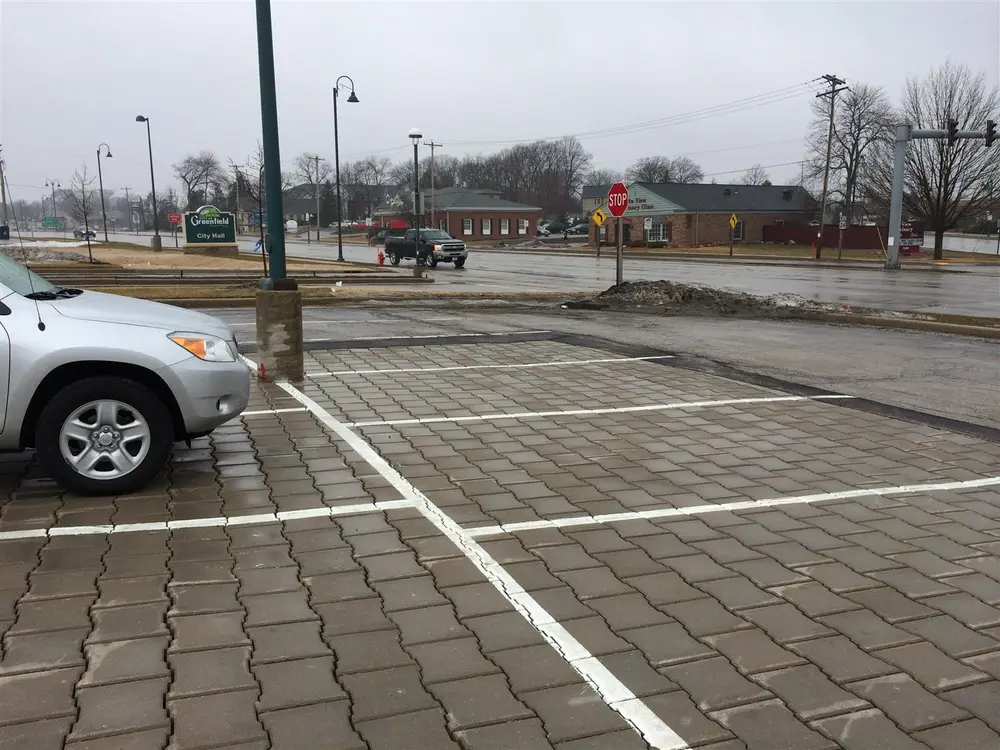 A car park with permeable paving. Water passes through the joints between the blocks into the gravel and soil below. Photo: Aaron Volkening — Wikimedia Commons, CC BY 2.0 (resized)
But there’s an important condition here that matters on the northern coastal strip. The Connecticut Stormwater Quality Manual says the seasonal high water table should be at least about 90 cm (3 feet) below grade, that permeable paving shouldn’t be used on slopes steeper than 15%, and that it should be at least 30 metres from a drinking-water well.
Now recall that in Daryakenar the water table is less than two metres down and rises and falls by more than a metre. So there are places on the coastal strip where, in the rainy season, even those 90 cm aren’t left, and permeable paving there doesn’t send the water anywhere. Before choosing it, know your own plot’s water table in the rainy season. We covered it in high groundwater and building foundations.
Sources: EPA — Soak Up the Rain: Permeable Pavement; Connecticut Stormwater Quality Manual — Permeable Pavement; Yousefi Roshan & Lorestan, groundwater fluctuations in Babol–Babolsar (in Persian)
Rain gardens: send the water to the right place
Another way is to give the water a place. The EPA defines a “rain garden” as a shallow depression in the landscape that collects rainwater from a roof, driveway or path and lets it soak slowly into the ground, planted with grasses and flowering perennials.
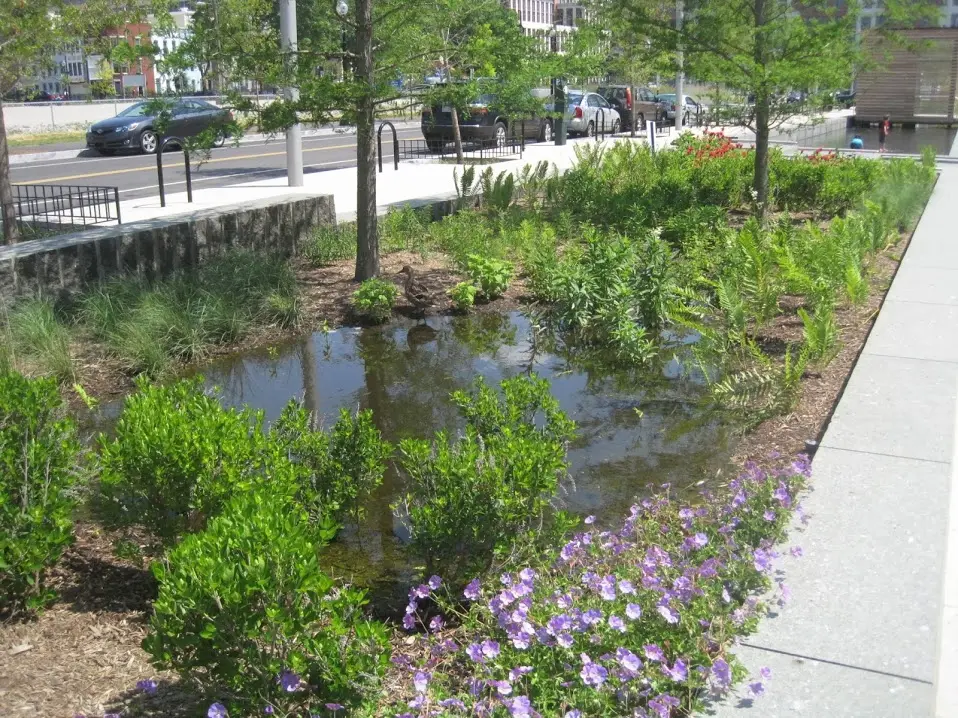 A rain garden after rain. Water collects here briefly and then soaks slowly into the ground. Photo: US Environmental Protection Agency (EPA) — Wikimedia Commons, public domain
But placement matters. The University of Connecticut’s NEMO programme has clear rules: if the house has a basement, keep the rain garden at least about 3 metres (10 feet) away; don’t build it over a septic system or near a drinking-water well; avoid steep slopes; and not in that low corner of the yard that’s always wet. As they put it, a rain garden isn’t a water garden or a wetland.
They also suggest a simple test you can do yourself: dig a hole 15–20 cm deep where you want the garden and fill it with water.
- If it empties within 6 hours, the spot is suitable.
- If it takes 6–24 hours, it’s probably acceptable, but the soil may need amending.
- If there’s still water after 24 hours, find another spot.
On the northern coastal strip with a high water table, do this test in the rainy season; a spot that drains in a few hours in summer may no longer take water in November.
Sources: EPA — Soak Up the Rain: Rain Gardens; UConn NEMO — Rain Gardens: Siting and Sizing
Where in the yard, what
| Place | Sensible choice | Why |
|---|---|---|
| All around the house | Ground sloping away, no beds against the wall | Water mustn’t collect at the foundation |
| At the foot of downpipes | Discharge away from the wall, to a rain garden or drain | Don’t send roof water back to the wall |
| Parking and paths | Permeable paving, if the water table allows | Let the water into the soil where it falls |
| The low, always-wet corner | Drainage, not a rain garden | The soil there no longer takes water |
| Over the septic drainfield | No parking, no roof water | The drainfield must stay free of loads and extra water |
The landscape continues the building
Good landscaping in the north isn’t work that starts after the building is finished; it’s planned from the first day of design, together with the downpipe positions, floor levels and the septic location. Then plants and trees also stay healthy for years, because their feet aren’t in water.
If you’re building a villa in Babol, Babolsar, Sarkhorud, Amol, Sari or Fereydunkenar and want its grounds to suit the northern rain from the start, get in touch.




No comments yet. Be the first.