


Picture late autumn. You’ve drained the villa pool to clean the tiles or fix a small crack. Overnight it pours with rain. In the morning something is off: the pool edge is no longer level with the patio, one corner has risen a few centimetres, and there are cracks all round it.
This isn’t fiction; it has a name — a floating pool — and the cause is the same Archimedes’ principle we learned at school. For villas on the coastal strip, where groundwater is only a few steps below your feet, that principle walks straight out of the textbook and into the garden.
Why does an empty pool rise?
Groundwater pushes up on the floor and walls of the pool. The upward force equals the weight of the water displaced by the submerged part of the shell. When the pool is full, the weight of the water inside cancels it out. Drain it, and only the concrete shell is left to hold it down. A forensic engineering report (Envista Forensics) says plainly that if the pool is emptied, or its water drops below the groundwater level, the pool will float.
Source: Envista Forensics — Floating Swimming Pools
What are the numbers in the north?
A study of groundwater fluctuations in the Babol–Babolsar area found that at Daryakenar, on the coast, the water table lies less than two metres below the surface, and moved by more than a metre over the study period. Now a rough sum for an ordinary villa pool:
- An 8 × 4 m pool, 1.5 m deep, with 20 cm concrete floor and walls: outer dimensions 8.4 × 4.4 m, its base about 1.7 m below ground.
- The shell is about 15 m³ of concrete. At roughly 2,400 kg/m³ for ordinary concrete, it weighs about 36 tonnes.
- Every cubic metre of water displaced pushes up with about one tonne.
| Water table | Submerged height of shell | Upward force | Empty pool |
|---|---|---|---|
| 1 m below ground | 0.7 m | about 26 t | less than 36 t — stays put |
| 30 cm below ground | 1.4 m | about 52 t | more than 36 t — lifts |
Sources: Yousefi Roshan & Lorestan, groundwater fluctuations Babol–Babolsar; Faradars — concrete density
Note that the only difference between the two rows is seventy centimetres of rising water — less than the fluctuation the same study reported for Daryakenar. A pool that was safely drained in summer may not survive the same job after the autumn rains. The sum is simplified, ignores soil friction and tile weight, and doesn’t replace an engineer’s calculation; but it shows the order of magnitude.
Solutions
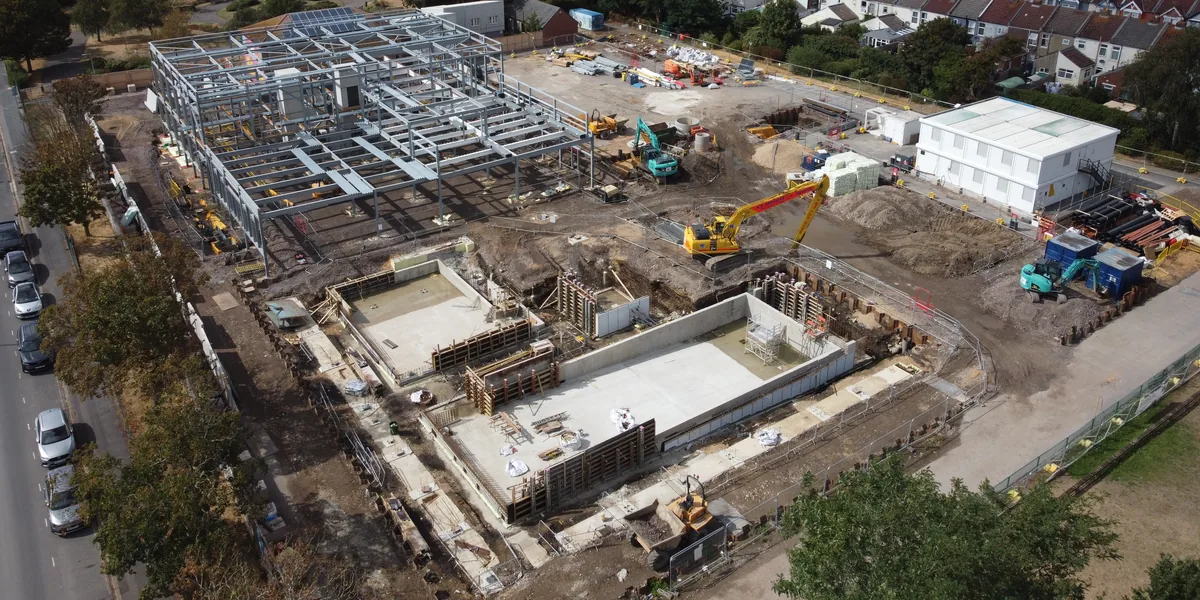
- Hydrostatic relief valve: the same report says concrete pools are usually fitted with a one-way valve at the deepest point that opens when pressure under the pool rises, letting groundwater in so the pool doesn’t lift. It also warns these valves can jam closed with dirt and debris.
- Measure the groundwater before building: check the water level during construction, and make sure surface water from the garden or neighbouring land isn’t directed towards the pool.
- Design for the worst level, not the day you dug: the shell’s weight and anchorage should be calculated by a structural engineer for the highest possible water level. Why the water level in the north isn’t fixed is covered in High Groundwater and Foundations.
- Don’t drain the pool after heavy rain, and if you must drain it, first make sure the relief valve works.
Source: Envista Forensics — Floating Swimming Pools
Indoor pools: the problem is the air, not the water
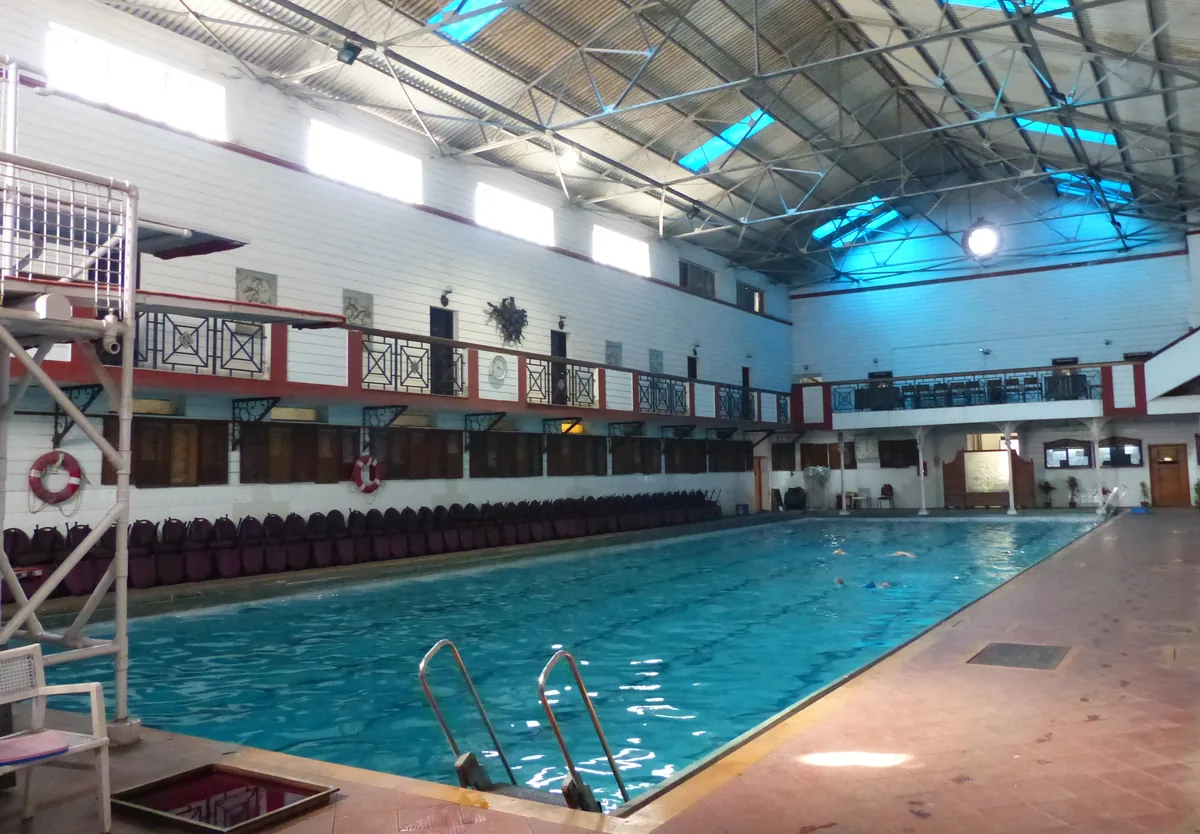
Many people enclose the pool so they can swim through the northern winter. Then the trouble changes: the warm water surface evaporates constantly. A design guide from the City of Mississauga, Canada, citing ASHRAE, recommends for a lap pool water at 26–29°C, hall air 2–4°F (about 1–2°C) warmer than the water but no more than 30°C, and relative humidity of 50–60%. It explains why: air warmer than the water reduces evaporation and the dehumidification load.
So a pool hall is a large vapour generator, and every cold surface in it — glass, window frames, ceiling corners — is a condensation point. If it has big windows onto the garden, window choice stops being a matter of taste. The dew-point logic is explained in Humidity, Condensation and Mould.
Source: City of Mississauga — Diving into Natatorium Environment
A hard lesson from Switzerland
On 9 May 1985 the roof of the indoor pool in Uster, Switzerland, collapsed: twelve people died and nineteen were injured. The heavy suspended ceiling hung from stainless steel stirrups — steel assumed to be “rust-proof”. Chlorine vapour had collected between the suspended ceiling and the real roof, formed a chloride film on the metal, and under load the stirrups broke one by one through stress corrosion cracking.
The lesson isn’t small for a villa either: pool-hall air is not ordinary house air. Every screw, hanger and metal fixing that lives there has to be chosen for chlorinated air, and ventilation must not let vapour get trapped anywhere.
Source: Dlubal — The swimming pool roof collapse in Uster
A few questions before building a pool
- How deep is the groundwater on our plot, and how much does it rise and fall over the year?
- Has the shell’s weight been checked against the highest water level?
- Is there a relief valve? Where, and how can it be inspected?
- Where does surface water from the garden go?
- If it’s indoors: what controls air humidity and temperature? Are roof metals and windows chosen for chlorinated air?
In short
On the coastal strip, an empty pool next to groundwater can behave like a boat, and the one-metre fluctuation at Daryakenar is enough to flip the result. With groundwater measurements, design for the worst level and a working relief valve, the risk is manageable. And if the pool is indoors, think about the hall’s air from day one, not just its water.
If you’d like a pool designed for a villa in Babol, Babolsar or Sarkhorud, get in touch.

No comments yet. Be the first.