

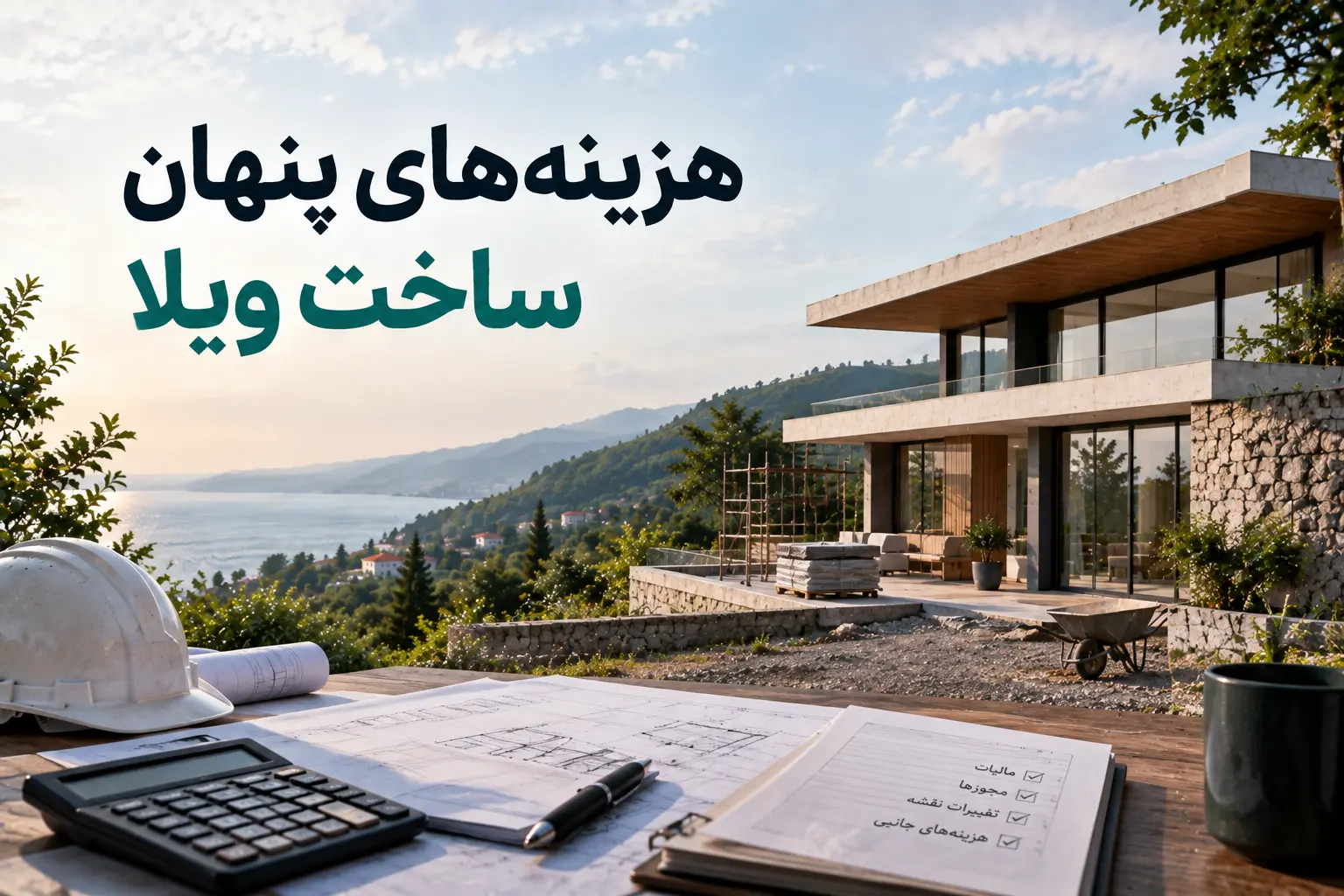
The first question anyone asks about building a villa is: “How much per square metre?” Whatever the answer, it gets multiplied by the floor area, and the result is called “the estimate”. But one group of costs never enters that sum: costs paid to institutions rather than to the builder — and some of them are a condition for getting the building permit or the completion certificate. Until they are paid, the project does not move.
We quote no prices in this article, for a simple reason: almost all of these costs are tied to figures that change every year — and the law itself says so. Instead, we say who charges each cost, when, and under which law, so you can ask that authority for the exact figure for your own plot.
The roadmap: which cost, when?
| Stage | Cost | Paid to |
|---|---|---|
| Before the permit | 1. Building permit fees | Municipality or village council |
| 2. Construction-worker insurance | Social Security Organization | |
| 3. Design and supervision fees | Designers; supervision via the Engineering Organization’s procedure | |
| 4. Soil investigation | Geotechnical laboratory | |
| During construction | 5. Licensed builder and site requirements | The licensed builder |
| 6. Changes during construction | The builder — and the municipality if the change exceeds the permit | |
| 7. Utility connections | Water, power and gas companies | |
| Completion | 8. Technical identity document and completion certificate | Engineering Organization and municipality |
| Throughout | 9. Time | Nobody — and everybody |
Before the permit
1. Building permit fees
Permit fees are collected by the municipality (or, in a village, the village council). But the municipality’s hands are not free. Iran’s Act on Sustainable Revenue and Expenditure of Municipalities and Village Councils (2022) sets three important limits:
- local fees are calculated on “the transaction values under Article 64 of the Direct Taxes Act”;
- “the maximum growth of local fees over the previous year is the rate of inflation” announced by the competent authorities;
- and “levying any fee other than those announced is prohibited”.
The more practical point is in note 3 of the same article: municipalities and village councils must publish “all fee titles and the method of calculating them” “by the end of Bahman [mid-February] at the latest, for application in the following year”. In other words, your town’s fee schedule is public — and you can read it before you buy the land, not after.
Source: Act on Sustainable Revenue and Expenditure of Municipalities and Village Councils, Article 2 — Majlis Research Center (Persian)
Whether the plot is inside a city, a village, or neither determines which authority issues the permit at all; we explain this in our building permit article.
2. Construction-worker insurance — a big surprise
This cost is missing from many early estimates, and by law no permit is issued without it. The Amendment to Article 5 of the Construction Workers’ Social Insurance Act (February 2023) sets the employer’s share for every square metre of floor area on every storey:
| Type of construction | Per square metre of floor area |
|---|---|
| Urban (municipal permit) | 4% of that year’s statutory monthly minimum wage |
| Rural (village council or district permit) | 1% of that year’s statutory monthly minimum wage |
| Rural “for temporary residence or tourism” | At the urban rate — i.e. 4% |
Source: Amendment to Article 5 of the Construction Workers’ Social Insurance Act, clause A and note 3 — Majlis Research Center (Persian)
The arithmetic is simple. For a 200 m² villa in a town: 200 × 4% = eight times that year’s monthly minimum wage.
And take the third row seriously. If your plot is in one of the villages around Babolsar and Sarkhorud, you might assume the 1% rate applies to you. But note 3 of the same article says that “rural construction for temporary residence or tourism is calculated at the urban coefficient”. If your villa is for temporary stays, do not close your budget at 1%.
The same law also contains two pieces of good news:
- at the applicant’s request, Social Security must spread this payment over “up to three years, without interest” (clause D);
- and the permit can be issued on the basis of an “instalment notice”, not only full payment (clause B).
But clause B also has a final condition: “issuing the completion certificate … is conditional on a settlement certificate from the Social Security Organization”. In other words, the last instalment must be paid before completion.
3. Design and supervision fees
The architectural drawings are only one set among several: structure, electrical and mechanical services each have their own designer, and supervision has a separate fee. The tariff for these services is announced every year: the 2026 (1405) tariff was issued to the provinces this spring by the head of Iran’s Building Engineering Organization, together with “the table of base construction costs”, “per square metre of building in the building groups”.
Source: Construction cost and engineering services tariff for 1405 announced — Mehr News Agency, 3 May 2026 (Persian)
Two key words in that sentence: “per square metre” and “building group”. So this cost rises both with floor area and with the building’s group — and one extra storey can push a villa into a higher group. The group table is in our guide to choosing an architecture firm. Ask the Mazandaran Building Engineering Organization for the exact figure for your year.
4. Soil investigation
On the coastal plots of Babolsar and Sarkhorud, a soil investigation is not a cost you can skip. Part 7 of the National Building Regulations (Persian) defines the geotechnical investigation of a site and the minimum number and depth of boreholes. It is the cheapest point in a project at which to find out how expensive the foundations will be — why, we explain in our groundwater and foundations article.
During construction
5. The licensed builder, and site requirements
Under Article 9 of the Executive Bylaw of Article 33 of the Engineering Act, construction must be carried out by a licensed builder and owners “are obliged to use such builders”; the builder’s fee is set by your contract. Who the licensed builder is, and how they differ from a contractor, is covered in architect, supervisor, licensed builder or contractor.
The same bylaw adds two smaller costs to the site:
- a project information board on the street before work starts; without it, the municipality prevents “starting or continuing work” (Article 39);
- a quality guarantee insurance policy in the owner’s favour, “in cases where” the builder is required to provide one (Article 18).
Source: Executive Bylaw of Article 33 of the Engineering and Building Control Act, Articles 9, 18 and 39 (Persian)
6. Changes during construction — a cost that arrives twice
“While we are building, let’s make this room bigger.” That sentence costs extra materials and labour, which everyone expects. But if the change goes beyond the permit, two more costs follow:
- The Article 100 commission of the Municipalities Act, which rules on construction that breaches the permit — from fines to a demolition order. We explain it in our building permit article.
- Insurance on the extra area — under clause E of the same construction-worker insurance law, if the Article 99 or 100 commission lets the extra area stand, the owner “must pay the insurance on the extra area and obtain a settlement certificate”.
The bylaw sets out the right way to make a change: under the note to Article 14, the builder must give the owner written reasons, and “any change requires the supervisor’s written permission”. And the cheapest place for a change is still on paper, not on site — the same point we make in the design mistakes that raise build cost.
7. Water, power and gas connections
Each connection has its own fee charged by the relevant company, and these figures are not fixed either. One example: the fee for a new electricity connection is set under Article 4 of the Electricity Industry Support Act (2015); its latest revision took effect on 18 December 2024.
Source: Electricity connection fees revised and announced — Bargh News, 25 December 2024 (Persian)
Completion
8. The technical and property identity document, and the completion certificate
When the building is finished, two documents remain. The technical and property identity document is issued by the provincial Engineering Organization, and its fee follows an annual tariff approved on the proposal of the Engineering Organization’s central council (Article 31 of the bylaw and its note 2). And under Article 35, the municipality issues the completion certificate “on the basis of” that document.
Remember: the completion certificate is also not issued without the Social Security settlement certificate (cost no. 2). And why a villa without a completion certificate is incomplete — from a separate title deed to a sale — is covered in our completion certificate article.
Sources: Executive Bylaw of Article 33, Articles 31 and 35; Amendment to Article 5 of the Construction Workers’ Social Insurance Act, clause B (Persian)
9. The cost on no invoice: time
Look again at three sentences of law quoted in this article:
- local fees may rise each year up to the rate of inflation;
- construction-worker insurance is tied to the minimum wage of that year;
- and the engineering services tariff is reissued every year.
So a project that slips by a year moves all of these figures with it — without a single extra brick being laid. A realistic schedule is itself a saving.
In short
“How much per square metre?” is not a bad question; it is only half of one. The other half is: who has accounted for the fees, the insurance, the engineering tariff, the soil test, the connections and the technical identity document? An estimate without them is not an estimate for a building; it is an estimate for a frame and its finishes.
Laws and tariffs change, and every town and village has its own procedure; ask the authority we have named for the exact figure in each case. And if you have a villa ahead of you in Babol, Babolsar or Sarkhorud and want an estimate that sees all nine of these items, get in touch.

No comments yet. Be the first.