

A finished villa has one big advantage: you’re no longer dealing with drawings and a builder’s promises. The building is right there. You can walk through it, open and close the doors, and see which room catches the afternoon sun.
But there’s a flip side: every decision has already been made, good and bad. The foundations are what they are, the roof is what it is, and if the builder added a storey the permit didn’t allow, that storey is about to become yours, along with all its problems. The only thing you can do is look properly and ask properly before you sign.
Most viewings go the same way: a sunny day, clean walls, and a seller talking about the sea view and how quiet the area is. None of it is untrue; it just isn’t the whole story. This article is about the things a viewing like that usually misses: four on paper, four on the building itself.
If you’re still looking for land rather than a finished villa, our land-buying checklist will help more.
Paperwork first
1. Is the villa inside the sea setback?
If the villa is in Babolsar or Sarkhorud and close to the beach, this is the first question, before you even step inside. Many people assume “it has a deed, so it’s fine”. The law says otherwise. Iran’s Coastal and Reclaimed Lands Act (1975) is clear on three points:
- the Caspian setback is 60 metres, measured from “the furthest advance of the water in 1342 [1963]” (Article 2(d));
- land that emerges as the water drops, “reclaimed land”, “belongs to the state, and individuals have no right to apply for its registration” (Article 3);
- and most importantly, the setback “cannot be privately owned or occupied, even if its occupants have obtained title deeds” (Article 7).
Source: Text of the Coastal and Reclaimed Lands Act (Persian)
So a deed on its own isn’t enough. And this matters more now than ever, because the Caspian is retreating. According to Iran’s National Caspian Sea Research Centre, the water level has dropped about two metres since 1996, around 26 cm in the last year alone. On gently sloping shores, a few tens of centimetres move the shoreline a long way: between 2014 and 2021, a drop of about 50 cm pushed the shoreline back 10 to 100 metres in some places. Land that looks “beachfront” today may be land that was underwater a few years ago, and that the law treats as state land.
Nor is this just theory. Recently, “on the order of the Sarkhorud district prosecutor … the 60-metre sea setback on the Sarkhorud coast” was cleared.
Source: The Caspian has retreated two metres — Asr-e Iran, citing Mehr, 19 August 2026 (Persian)
What to do: before you pay a single rial of deposit, ask the county Natural Resources office how far the property is from the setback line and whether it is reclaimed land. If the seller keeps stalling on this enquiry, that tells you something.
2. Does it have a completion certificate?
You’ll often hear: “We’ll get the completion certificate later, it’s no big deal.” Maybe it isn’t; maybe it is. What’s certain is this: under note 8 of Article 100 of Iran’s Municipalities Act, a notary must see the “building completion certificate”, or for an unfinished building a “certificate of no violation”, before a final sale and record it in the deed. You can buy a villa without one on a private agreement, but its formal transfer gets stuck.
Source: Municipalities Act, Article 100 and its notes (Persian)
So the real question isn’t “does it have one?” but “if not, why not?” “We never got round to it” is one story. “The building doesn’t match its permit” is a completely different one. The full picture is in our completion certificate article.
3. Was it built the way the permit allowed?
It’s common in the north: an extra storey, a basement that wasn’t on the permit, a light well roofed over and turned into a room. Sellers usually count these as “extra floor area” and price them in. But any construction that breaches the permit ends up before the Article 100 Commission, which can impose anything from a fine to a demolition order (explained in our building permit article).
And even if the commission lets the extra area stand, that’s not the end of it: under the construction-workers’ insurance law, insurance must also be paid on that extra area and a clearance obtained. It’s one of those hidden costs nobody usually counts.
Source: Amendment to Article 5 of the Construction Workers’ Social Insurance Act, clause E (Persian)
What to do: ask for the permit and compare its floor area and number of storeys with what’s in front of you. If the seller’s figure is bigger than the permit’s, that gap will surface when you apply for a completion certificate or a certificate of no violation, and it’ll be your problem, not the seller’s.
4. Where are the technical file and the as-built drawings?
Few buyers know about this one. Under Article 32 of the bylaw implementing Article 33 of the Engineering and Building Control Act, for buildings permitted after the bylaw took effect, the technical and property identity document “must be handed to the buyer in every transfer … together with the as-built drawings”. Asking for it is your right, not a favour.
As-built drawings show what was actually built: where the pipes run, which walls carry load and must not be touched. A few years on, when you want to redo the kitchen, you’ll be glad you have them.
The same bylaw gives one more lead: the name of the licensed builder is recorded on the permit, and where it’s required, the licensed builder must take out quality-guarantee insurance “in favour of the owner or subsequent owners”. “Subsequent owners” means you. So ask whether such a policy exists. How the licensed builder differs from the other roles is in architect, supervisor, licensed builder and contractor.
Source: Bylaw implementing Article 33 of the Engineering and Building Control Act, Articles 10, 18 and 32 (Persian)
Then the building itself
One simple tip first: view a northern villa after a few days of rain, not on a sunny summer day. Rain shows exactly what sunshine hides. And if the walls have just been painted, look even more carefully. Fresh paint doesn’t necessarily mean something is being hidden, but it does mean you can no longer see old stains.
5. Damp and mould — corners and behind wardrobes
Look at the corners where ceiling meets outside wall, open the built-in wardrobes and check behind them, and step into a room that’s been shut for a while; a damp smell gives itself away quickly. One important point: if the mould is in the corners of outside walls rather than near pipes, the cause is probably condensation and thermal bridging. That means it’s rooted in how the building envelope was designed, and a simple repair won’t fix it. The full explanation is in humidity, condensation and mould in northern villas.
6. Basement, foundations and cracks
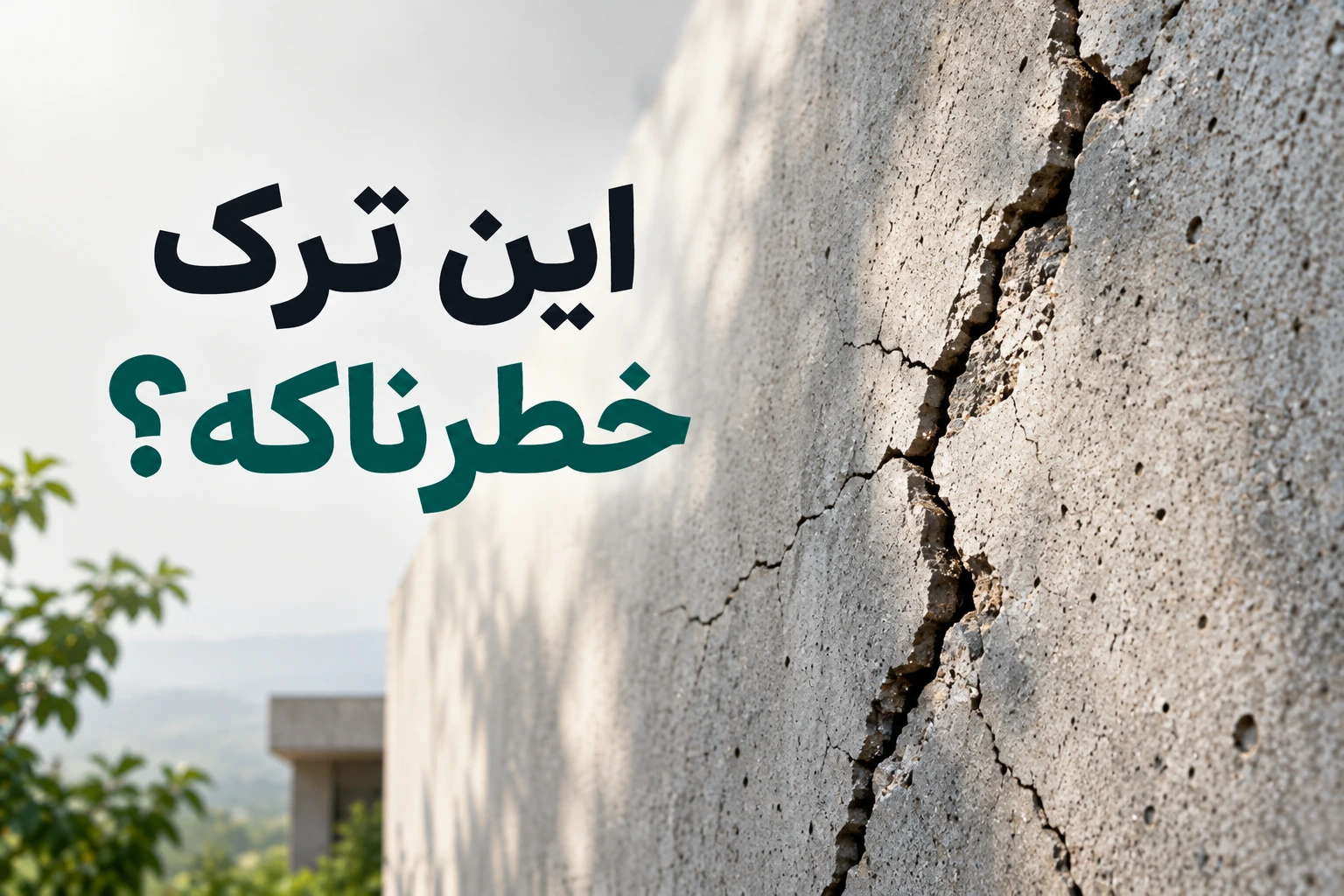
If the villa has a basement, start there. Damp or water marks on basement walls and floor are a serious sign on land with high groundwater. Diagonal cracks beside doors and windows, or a door that no longer closes properly, can point to settlement; get an engineer to look. Why groundwater on the Mazandaran coast matters so much for foundations is in high groundwater and foundations.
7. The roof
Look at the roof from underneath, not from on top: water stains on the top-floor ceiling, darkened timber in the roof space, and whether the roof space has any ventilation openings at all. Check the gutters too: where do they empty? At the foot of the wall, or away from the building? The criteria are in pitched roof or flat roof.
8. The facade
White salt stains on stone, brick that’s darker at the bottom of the wall than at the top, render that’s flaking: all signs the facade is soaking up water. And a facade that soaks up water passes the damp to the wall behind it. Which materials last in this climate, with figures, is in facade materials for a humid climate.
If you’re the seller
This list works for you too, just from the other side of the table. A serious buyer will ask exactly these things: the setback enquiry, the completion certificate, the permit, the technical file. Have them ready in advance and the sale moves faster, with less room for haggling over “uncertainties”.
In short: what to ask, and where
| What | Where |
|---|---|
| Sea setback and reclaimed land | County Natural Resources office |
| Completion certificate or certificate of no violation | Municipality, or the village council in a village |
| Whether the building matches its permit | The building permit, compared with the building |
| Technical file, as-built drawings, licensed builder’s name | The seller — the bylaw makes them the buyer’s right |
| Damp, foundations, roof and facade | A viewing after rain, with an engineer |
This article isn’t legal advice, and every town and village has its own procedures; for the contract, talk to a lawyer or an official expert. And if you’d like an architect to come and look at a villa in Babol, Babolsar or Sarkhorud with you before you buy, get in touch.

No comments yet. Be the first.